
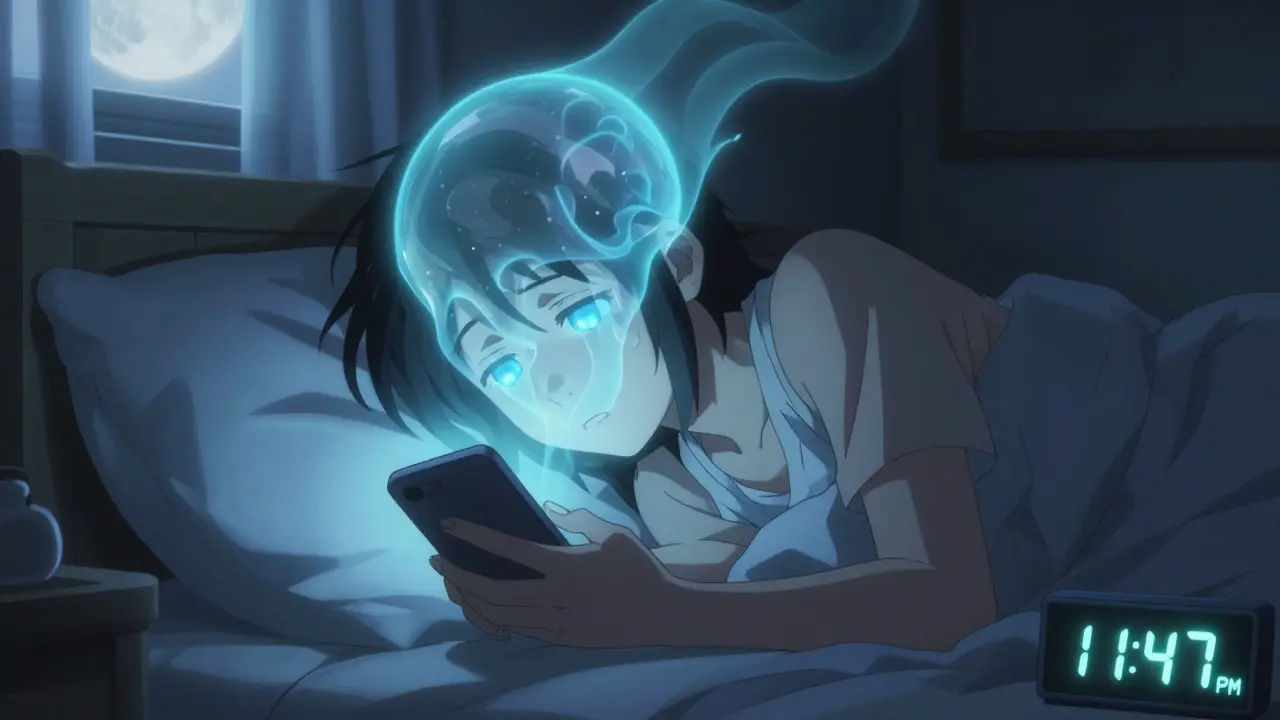
Most people know they should put their phones down before bed. But few realize blue light is the real culprit behind why they still toss and turn, even after hours of lying still. It’s not just about distraction or scrolling too long-it’s biology. Your brain doesn’t know the difference between sunlight and the glow from your phone. And when it gets that signal at night, it shuts down the one hormone that tells you it’s time to sleep: melatonin.
Why Blue Light Disrupts Sleep
Blue light is part of the visible light spectrum, with wavelengths between 400 and 495 nanometers. It’s naturally abundant in daylight and helps keep you alert during the day. But when you’re exposed to it after sunset, especially from screens, it tricks your body into thinking it’s still morning. The key players here are special cells in your eyes called intrinsically photosensitive retinal ganglion cells (ipRGCs). These cells don’t help you see images-they send signals straight to your brain’s internal clock, telling it whether it’s day or night. Research from Harvard Medical School in 2012 showed that six and a half hours of blue light exposure suppressed melatonin for about three hours. Compare that to green light, which only cut melatonin by 1.5 hours. That’s a huge difference. Modern LED screens emit 30-40% blue light, compared to just 15% from old incandescent bulbs. So even if your phone isn’t blazing bright, it’s still flooding your system with the wrong kind of light at the wrong time.What Happens When You Use Screens Before Bed
Let’s say you scroll through Instagram for 90 minutes before turning off the lights. You’re not just losing time-you’re disrupting your sleep architecture. Studies show this kind of exposure delays your sleep onset by 15-20 minutes on average. More importantly, it reduces your deep sleep and REM cycles, which are critical for memory, emotional regulation, and physical recovery. A 2023 study in Scientific Reports found that using a smartphone at 30 cm for two hours before bed exposed users to 30-50 lux of blue light. That’s enough to slash melatonin production by half compared to dim red light. And here’s the kicker: you probably don’t even notice it. Your eyes adjust to the brightness, so you think you’re fine. But your brain is screaming, “It’s daytime!”How Much Screen Time Is Too Much?
The American Academy of Sleep Medicine says: avoid screens for at least one hour before bed. That’s the minimum. But if you really want better sleep, aim for 90 minutes. Why? Because melatonin starts rising about 90 minutes before your natural sleep time. If you’re still staring at a screen during that window, you’re blocking the signal your body needs to wind down. A Sleep Foundation survey found that 83% of people who stuck to a 90-minute screen-free rule cut their time to fall asleep from over 45 minutes down to under 20. That’s not magic-it’s biology. And the effect compounds over time. People who consistently avoid screens before bed report fewer nighttime awakenings, deeper sleep, and more energy in the morning.
Blue Light Filters: Do They Work?
Apple’s Night Shift, Android’s Night Light, and apps like f.lux reduce blue light by shifting your screen to warmer tones. They’re not a cure-all, but they help. DisplayMate Technologies measured that these modes cut blue light emission by about 60%. That’s meaningful-but not enough on its own. A 2023 review of studies found that people wearing blue-light-blocking glasses for two hours before bed saw improvements in sleep satisfaction and duration. But here’s the twist: a University of Toronto study found no difference in melatonin levels between people wearing blue-blocking goggles and those in regular dim light. Why? Because the real issue isn’t just blue light-it’s total light intensity. Even warm light can suppress melatonin if it’s too bright. So here’s the rule: if you must use a screen at night, make it dim. Keep brightness below 50 nits (about 30% of max). Sit at least 40 cm away. And never use screens in total darkness-that’s the worst combo. Your pupils are wide open, soaking up every photon.What Works Better Than Filters
Blue light filters are easy. But the real game-changer is replacing screen time with a wind-down routine. Try reading a physical book under a warm lamp. Take a warm shower. Do light stretching. Listen to calming music or a podcast without visuals. These activities don’t just reduce light exposure-they lower your heart rate and quiet your mind. A University of Glasgow study found it took people an average of 5.7 days to build a consistent habit of avoiding screens before bed. That’s not long. But it takes discipline. You have to treat bedtime like a ritual, not an afterthought. And here’s something most people miss: daylight matters just as much as nighttime. If you get less than 30 minutes of natural sunlight in the morning, your internal clock gets confused. That makes blue light at night even more disruptive. So go outside after waking up. Even on a cloudy day, daylight is 10-20 times brighter than any indoor light.What About Blue Light Glasses?
They’re popular-and for good reason. Amazon reviews show 68% of users say they fall asleep faster. But 22% say the yellow tint makes reading or working on screens uncomfortable. They’re not perfect, but if you work late or can’t avoid screens, they’re a solid backup. Look for glasses that block 90% of blue light between 400-450 nm-the most disruptive range. Avoid cheap ones that just tint everything orange. Good ones look amber, not neon yellow. And don’t wear them all day. You need blue light during daylight to stay alert and regulate your rhythm.
Why This Matters Beyond Sleep
Poor sleep from blue light exposure doesn’t just leave you tired. Chronic disruption is linked to higher risks of obesity, diabetes, heart disease, and even depression. Dr. Charles Czeisler from Brigham and Women’s Hospital has called it a “public health issue.” Your circadian rhythm isn’t just about sleep-it affects your metabolism, immune function, and hormone balance. Even if blue light isn’t the only factor, it’s one you can control. And that’s powerful. You don’t need to quit screens. You just need to stop using them at the wrong time.Simple Steps to Start Tonight
You don’t need to overhaul your life. Start small:- Set a screen curfew: 90 minutes before your target bedtime. Use your phone’s built-in timer or a simple alarm.
- Turn on Night Shift or f.lux-but also lower brightness to 30% or less.
- Keep devices out of the bedroom. Charge your phone in the kitchen or living room.
- If you must check something, use a dim red lamp instead of your phone.
- Get 15-30 minutes of morning sunlight within 30 minutes of waking up.
What’s Next for Blue Light Research
Scientists are now looking at personalized light exposure. Chronomics launched a test in early 2024 that analyzes your genes to see how sensitive you are to blue light. Some people are naturally more affected than others. That means the “one-size-fits-all” rule might soon become outdated. Apple’s Sleep Focus mode, introduced in iOS 17 in September 2023, automatically dims your screen and silences notifications an hour before your scheduled bedtime. It’s a step forward. The FDA is also reviewing blue light guidelines, with updates expected by late 2024. But here’s the truth: you don’t need new tech to fix this. You just need to change your habits. And the best part? You’ll feel the difference in just a few days.Does blue light from screens really affect sleep?
Yes. Blue light, especially between 460-480 nanometers, suppresses melatonin, the hormone that signals sleep. Studies show even one hour of screen use before bed can delay sleep onset by 15-20 minutes and reduce sleep quality. The effect is strongest in low-light environments where your pupils are dilated.
How long before bed should I stop using screens?
The American Academy of Sleep Medicine recommends at least one hour without screens. For better results, aim for 90 minutes. This gives your body enough time to naturally raise melatonin levels. People who follow this rule report falling asleep faster and sleeping more deeply.
Are blue light glasses worth it?
They can help, especially if you work late or can’t avoid screens. About 68% of users report improved sleep. But they’re not a magic fix. If your screen is still bright or you’re using it in the dark, glasses alone won’t solve the problem. Combine them with lower brightness and screen-free time.
Does Night Shift or f.lux make a big difference?
Yes, but only partially. These features reduce blue light by about 60%, which helps. But total light intensity matters more than color. A dim red light is better than a bright warm screen. Always lower brightness to 30% or below, even with filters turned on.
Can I still use my phone if I wear blue light glasses?
Technically yes, but it’s not ideal. The problem isn’t just blue light-it’s the mental stimulation from scrolling, messaging, or watching videos. Even with glasses, your brain stays alert. The best approach is to replace phone use with a calming activity like reading a book or listening to quiet music.
Why do I still feel tired even after sleeping 8 hours?
Blue light exposure before bed can reduce deep sleep and REM cycles, which are essential for restorative sleep. You may sleep long, but not well. Other factors like stress, caffeine, or irregular sleep schedules can also contribute. Try cutting screens 90 minutes before bed for a week and track how you feel in the morning.


Been doing the 90-minute no-screen rule for three weeks now. Honestly? I didn’t think it’d make that much difference. Turns out I was sleeping like a zombie-waking up groggy, no matter how long I slept. Now I read physical books before bed. Feels like my brain finally got a vacation.