
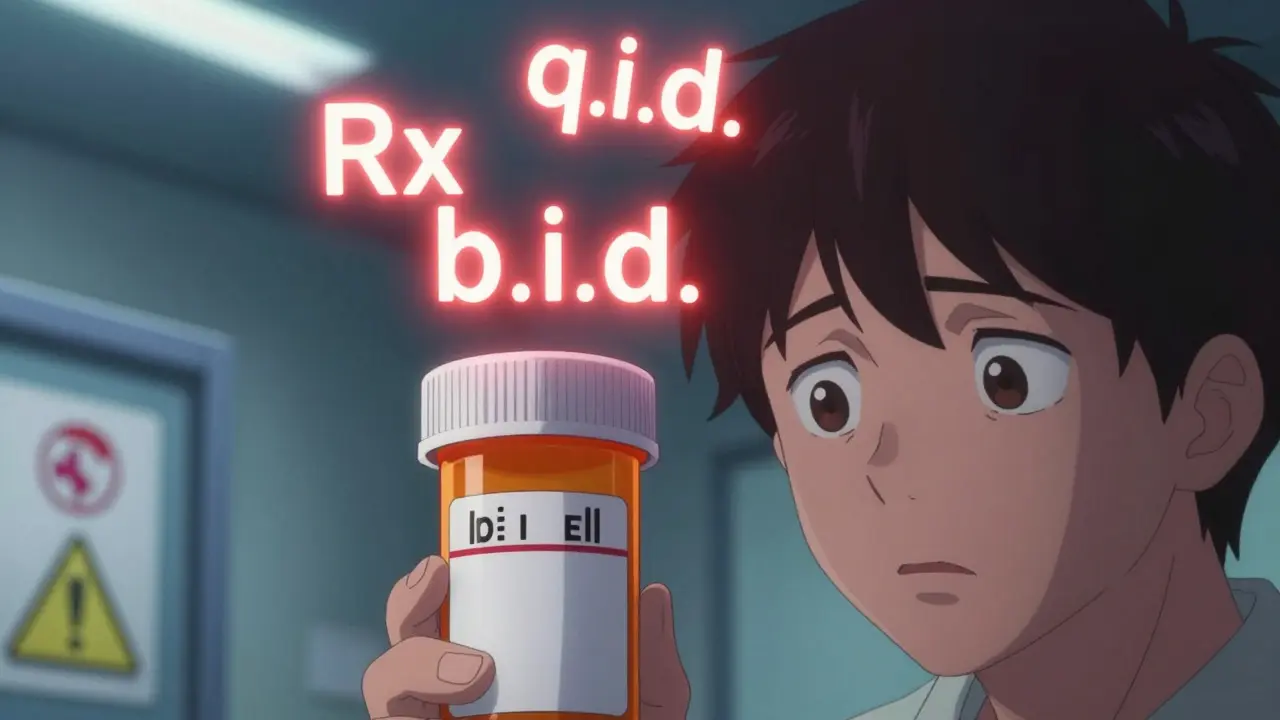
Have you ever looked at your prescription label and felt like you were reading a secret code? Prescription abbreviations are everywhere - on the bottle, in the instructions, even in the fine print. But what do they really mean? And why do they still exist when they can cause dangerous mistakes?
Every year, thousands of people in the U.S. experience medication errors because of confusing abbreviations on prescriptions. Some of these errors lead to hospital visits. Others are narrowly avoided thanks to a pharmacist catching a mistake. This isn’t about old-school handwriting or outdated habits. It’s about safety - and the system is changing fast.
What Does "Rx" Really Mean?
You’ve seen it: the symbol "Rx" at the top of every prescription. It looks like a weird mix of letters and a cross. But it’s not random. "Rx" comes from the Latin word "recipe," which means "take." It was used by ancient Roman physicians to signal that this was a medical instruction. By the late 1500s, it became standard on prescriptions across Europe. Today, it’s still the universal symbol for a prescription - even though most people have no idea what it stands for.
But here’s the problem: some abbreviations are too easy to mix up. "U" for units? That’s been linked to over 12 deaths in Pennsylvania alone between 2018 and 2022. Why? Because "U" can look like "0" or "4," especially on handwritten scripts. A patient might get 10 times the dose they were supposed to. That’s why the Joint Commission banned "U" in 2004. But you still see it sometimes - especially from older doctors using paper scripts.
Common Abbreviations You Need to Know
Here are the most common ones you’ll find on your prescription label - and what they really mean:
- p.o. - "per os" - means "by mouth." You’re taking it orally.
- b.i.d. - "bis in die" - twice a day. Not "every 12 hours" - that’s different.
- t.i.d. - "ter in die" - three times a day.
- q.d. - "quaque die" - daily. But this one is risky. Many people read it as "q.i.d." (four times a day) by mistake. That’s why many pharmacies now write "daily" instead.
- q.i.d. - "quater in die" - four times a day.
- PRN - "pro re nata" - "as needed." This doesn’t mean "take whenever you feel like it." It means take it only if you have the symptom, like pain or anxiety, and only within the daily limit.
- o.d. - "oculus dexter" - right eye.
- o.s. - "oculus sinister" - left eye.
- a.d. - "auris dexter" - right ear.
- a.s. - "auris sinister" - left ear.
- SC or SubQ - subcutaneous. This means under the skin, not into the vein.
- OTC - over-the-counter. This doesn’t mean it’s safe to mix with your prescription. Always ask your pharmacist.
These aren’t just random letters. They’re shorthand for Latin phrases that date back hundreds of years. But here’s the catch: in modern medicine, those shortcuts are becoming dangerous.
Why These Abbreviations Are Dangerous
It’s not just about confusion. It’s about deadly consequences.
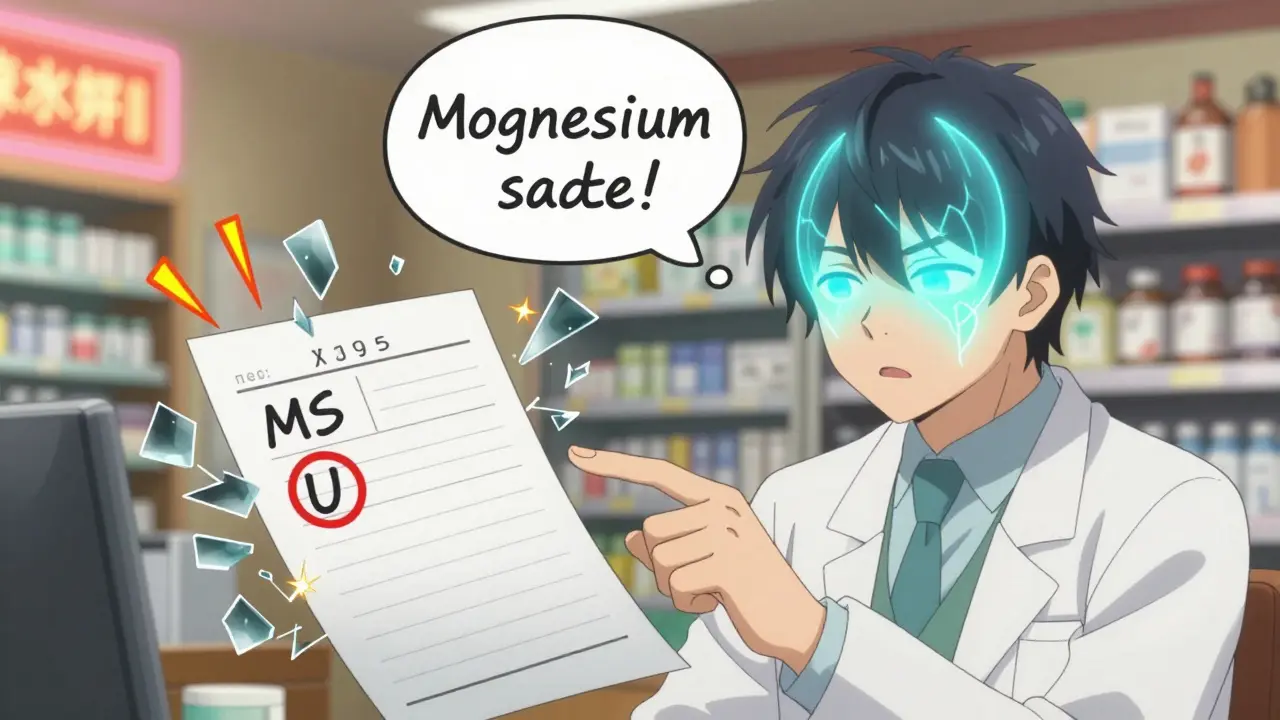
Take "MS." To some, it means morphine sulfate. To others, it means magnesium sulfate. One is a powerful painkiller. The other is used for seizures and preeclampsia. Mix them up? You could stop someone’s breathing or cause a heart attack. In 2023, the American Hospital Association reported 1,873 cases where "SC" (subcutaneous) was misread as "SL" (sublingual), leading to insulin being placed under the tongue instead of under the skin. That’s not a small mistake. That’s a life-threatening error.
Another big one: "1.0 mg." Sounds harmless, right? But if the decimal point gets smudged, it could be read as "10 mg." That’s a tenfold overdose. That’s why the Joint Commission now requires leading zeros (0.5 mg) and bans trailing ones (1.0 mg). Still, handwritten prescriptions slip through.
And then there’s "OD." To most people, it means "overdose." But on a prescription, it means "right eye." In 2022, the American Academy of Ophthalmology found that 2,147 patients got eye drops in the wrong eye because of this confusion. One woman nearly lost vision in her good eye because she was given glaucoma drops in the wrong eye - all because the doctor wrote "OD" and the pharmacist didn’t catch it.
How Pharmacies Are Fixing This
Thankfully, pharmacies aren’t just accepting these risks. They’re fighting back.
Most major chains - CVS, Walgreens, Walmart - now require two checks on every prescription. First, an automated system flags risky abbreviations. Second, a pharmacist reviews the label before handing it over. And here’s the most important part: patient labels now use plain English.
Walmart’s policy, updated in 2023, says: no more "b.i.d." It says "twice daily." No more "q.d." - it says "once daily." No more "PRN" - it says "as needed for pain." This isn’t just nice. It’s life-saving.
Electronic prescribing (e-prescribing) has also changed the game. Systems like Epic and Cerner automatically convert "U" to "units," "MS" to "morphine sulfate," and "q.d." to "daily." They even block prescriptions that use banned abbreviations. As of 2023, 92.4% of U.S. hospitals use these systems. The result? A 43.2% drop in abbreviation-related errors.
But not all prescriptions come from hospitals. Many still come from clinics, urgent care centers, or older doctors using paper scripts. That’s why community pharmacies still see 19.3% of their errors tied to confusing abbreviations - especially mixing up eye and ear codes (o.d. vs a.d.) or misreading "q.d." as "q.i.d."
What You Can Do
You don’t need to memorize all 487 abbreviations. But you do need to be your own safety net.
- Ask for plain English. If your label says "t.i.d." or "q.i.d.", ask the pharmacist to write it out. They’re required to explain it.
- Double-check dosages. If it says "1.0 mg," ask if it’s really 1 milligram - not 10. Ask them to show you the bottle.
- Know your meds. If you’re on insulin, blood thinners, or seizure meds, ask specifically: "Is this the right one?" Don’t assume.
- Use the pharmacy app. Most pharmacies now send digital labels. Check them before you pick up the pill bottle.
- Report confusion. If you see an abbreviation you don’t understand, tell the pharmacist. They’ll update their training.
One pharmacist on Reddit shared a story: "I had a patient bring in a script that said 'MSO4.' We thought it was morphine sulfate. Then we checked - it was magnesium sulfate. We called the doctor. He meant magnesium. We saved a life that day. Now we never guess. We always call."
The Future: No More Latin
The writing is on the wall. The World Health Organization wants all prescriptions to use English-only terms by 2030. The U.S. Pharmacopeia’s new rules, effective May 1, 2024, require prescribers to use "standardized English terms" - with only a few exceptions like "mg," "mL," and "mcg."
AI tools are already doing the work. IBM Watson Health’s MedSafety AI converts every abbreviation to plain language with 99.2% accuracy. Hospitals using it report zero abbreviation-related errors in the last year.
Some doctors still argue that removing Latin abbreviations slows them down. But the data doesn’t lie. The UK banned almost all abbreviations in 2019. Within two years, dispensing errors dropped by 28.7%. Hospitals in the U.S. that fully adopted standardized language cut errors by 37.6%.
It’s not about tradition. It’s about survival. Every time you see "Rx," remember: it’s not magic. It’s medicine. And medicine should be clear - not coded.
What does "Rx" mean on a prescription?
"Rx" comes from the Latin word "recipe," which means "take." It’s been used since the 1500s to indicate a medical prescription. Today, it’s just a symbol - not an instruction. You don’t need to do anything with it. It’s simply the label that says this is a prescription medication.
Why are abbreviations like "U" and "MS" dangerous?
"U" for units can look like "0" or "4," leading to 10-fold dosing errors. "MS" could mean morphine sulfate (a painkiller) or magnesium sulfate (used for seizures). Mixing them up can cause breathing problems, heart failure, or death. These abbreviations were banned by the Joint Commission in 2004 and 2023, respectively, but they still appear on handwritten prescriptions.
Is "q.d." the same as "daily"?
Yes, "q.d." means daily. But it’s risky because it looks too much like "q.i.d." (four times daily). Many patients and even some pharmacists misread it. That’s why most pharmacies now write "daily" instead. Always check the label - if it says "q.d.," ask for clarification.
What should I do if my prescription label uses confusing abbreviations?
Ask the pharmacist to explain it in plain English. You have the right to understand how to take your medicine. Most pharmacies will rewrite the label for you. If they don’t, ask to speak to the pharmacy manager. You can also request a digital copy through your pharmacy’s app - those are usually clearer.
Are eye and ear abbreviations still used?
Yes - but they’re being phased out. "o.d." means right eye, "o.s." means left eye. "a.d." and "a.s." mean right and left ear. These are still used because they’re short, but they’ve caused dozens of errors each year. Many pharmacies now write "right eye," "left eye," etc., on patient labels. If you see "o.d." or "a.d." on your script, double-check with your pharmacist.


I can't believe we're still using Latin abbreviations in 2024. It's like driving a Model T and calling it 'vintage.' I had a neighbor nearly die because her pharmacist read 'MS' as morphine instead of magnesium. She went into cardiac arrest. The doctor had handwritten it. No one questioned it. No one. And now we're supposed to trust handwritten scripts? This isn't tradition. It's negligence. I'm done with this system.