
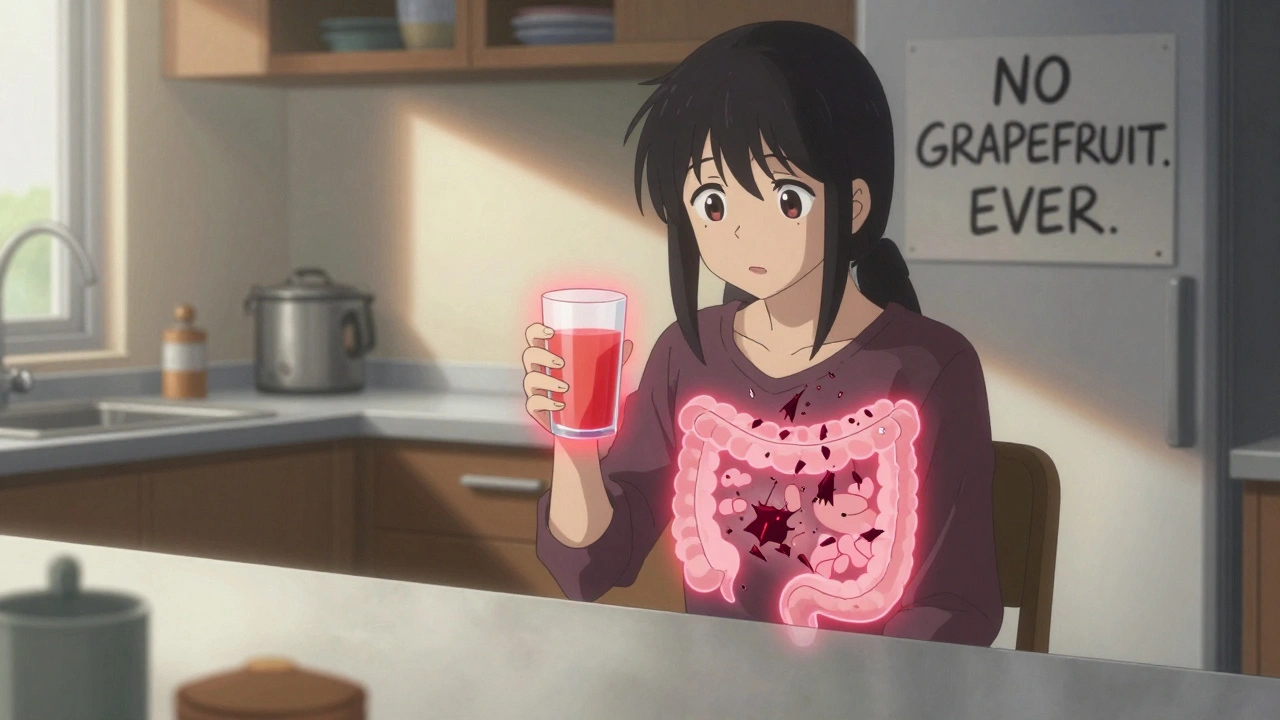
One glass of grapefruit juice might seem like a healthy start to your day-rich in vitamin C, low in calories, and full of antioxidants. But if you’re taking an immunosuppressant after a transplant, that glass could be dangerously close to a medical emergency. This isn’t a myth. It’s not a warning you can ignore. And it’s not something that only happens if you eat a whole fruit. Just 200 milliliters-less than a cup-of grapefruit juice can push your drug levels into toxic territory.
Why Grapefruit Changes How Your Medication Works
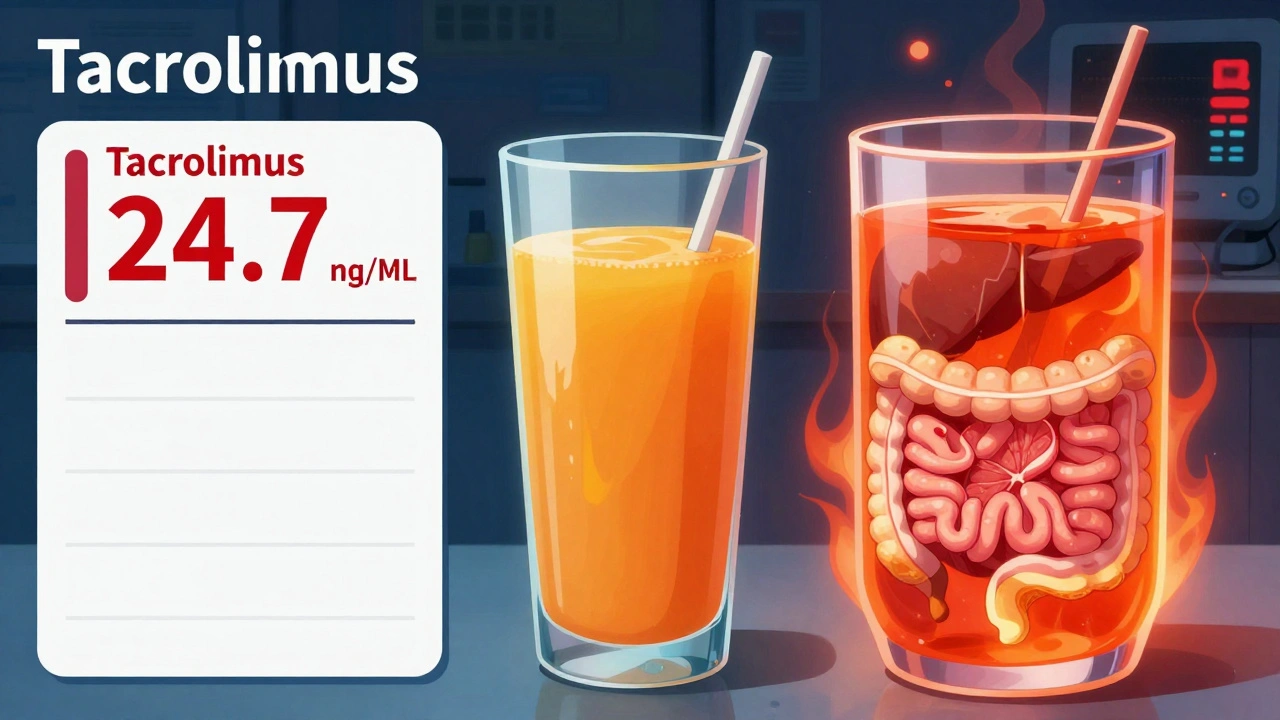
Your body uses an enzyme called CYP3A4 to break down many drugs before they enter your bloodstream. This enzyme lives mostly in your small intestine and acts like a gatekeeper, controlling how much of a drug actually gets absorbed. For immunosuppressants like cyclosporine, tacrolimus, and sirolimus, this gatekeeper is critical. These drugs are designed to work in very tight ranges. Too little, and your body rejects the transplant. Too much, and you risk kidney failure, nerve damage, or life-threatening infections. Grapefruit doesn’t just slow down this process. It shuts it down-permanently-for up to 72 hours. The culprits are chemicals called furanocoumarins, especially 6',7'-dihydroxybergamottin (DHB) and bergamottin. These compounds bind to CYP3A4 and destroy it. Your body can’t make new enzyme fast enough to replace what’s lost. So when you take your medication after even a small amount of grapefruit, nearly all of it rushes into your blood at once. Studies show grapefruit juice can boost cyclosporine levels by 50% to 100%. For tacrolimus, the increase is 30% to 50%. With sirolimus, the jump can be as high as 200% to 300%. These aren’t theoretical numbers. Real patients have seen their tacrolimus levels spike from 8.2 ng/mL to 24.7 ng/mL after one glass of juice. The safe range for tacrolimus is 5 to 15 ng/mL. Anything above 20 ng/mL is considered toxic.Which Immunosuppressants Are Most at Risk?
Not all immunosuppressants react the same way. The ones most affected share three key traits:- They’re broken down heavily by CYP3A4 in the gut
- They have low natural absorption-only 20% to 50% of the dose usually gets into your blood
- They have a narrow therapeutic window-your toxic dose is only 2 to 4 times higher than your effective dose
- Cyclosporine (Sandimmune, Neoral): Used in kidney, liver, and heart transplants. Toxic levels can cause kidney damage, high blood pressure, and tremors.
- Tacrolimus (Prograf, Envarsus XR, Astagraf XL): The most common immunosuppressant today. Even small increases can lead to nerve toxicity, kidney failure, or severe infections.
- Sirolimus (Rapamune): Often used when kidney toxicity from other drugs becomes a problem. Grapefruit can double or triple its levels, increasing risks of lung inflammation and high cholesterol.
What Counts as ‘Grapefruit’?
It’s not just the fruit you buy at the grocery store. Grapefruit interactions come from any form of the fruit:- Fresh grapefruit (even half a fruit)
- Grapefruit juice (even if it’s 100% natural or freshly squeezed)
- Grapefruit extract in supplements or smoothies
- Products containing grapefruit flavoring (some teas, candies, or yogurts)
How Long Does the Danger Last?
This is where most people get it wrong. They think, “I had grapefruit yesterday-I’m fine today.” Not true. The enzyme damage is irreversible. Your body needs time to grow new CYP3A4 enzymes. Studies show that after one glass of grapefruit juice:- At 24 hours: 47% of enzyme activity still blocked
- At 48 hours: 35% still blocked
- At 72 hours: 24% still blocked
What Happens When Levels Go Too High?
Toxic immunosuppressant levels don’t just make you feel unwell-they can destroy organs and leave you fighting for your life.- Kidney damage: Cyclosporine and tacrolimus are toxic to the kidneys. High levels can cause acute kidney injury, requiring dialysis.
- Nerve damage: Tremors, headaches, and seizures are common signs of tacrolimus toxicity.
- High blood pressure: A sudden spike can trigger heart attacks or strokes.
- Severe infections: Over-immunosuppression means your body can’t fight off even minor bacteria or viruses. Pneumonia, sepsis, and fungal infections become life-threatening.
- Electrolyte imbalance: High potassium levels (hyperkalemia) from grapefruit-drug interactions can cause irregular heartbeats and cardiac arrest.
What Should You Do Instead?
The solution isn’t complicated: avoid grapefruit and related citrus completely. But avoiding it isn’t always easy. Many people eat grapefruit because they believe it’s healthy. And it is-nutritionally. Half a grapefruit gives you 70% of your daily vitamin C, 5% of your potassium, and 2 grams of fiber. But no amount of nutrition justifies risking your transplant. Here’s what to do:- Read your medication guide. Every FDA-approved immunosuppressant has a warning about grapefruit. Look for the bolded “CONTRAINDICATED” label.
- Ask your pharmacist. They’re trained to catch these interactions. Show them your full list of meds and supplements.
- Use a drug-interaction app. Johns Hopkins launched a free app in 2023 that scans your prescription barcode and flags grapefruit risks instantly.
- Keep a food journal. If you’re unsure whether you’ve had grapefruit, write it down. Even a small sip matters.
- Replace grapefruit with safe citrus: oranges, tangerines, lemons, or limes.
What If You Accidentally Ate It?
If you ate grapefruit and you’re on an immunosuppressant, don’t panic-but don’t wait either.- Call your transplant team immediately. Don’t wait for symptoms.
- Expect a blood test. Your drug levels will be checked within 24 to 48 hours.
- Your dose may be lowered by 25% to 50% until levels return to normal.
- Even if you feel fine, get tested. Toxicity doesn’t always cause obvious symptoms.
Why Do So Many People Ignore This Warning?
A 2023 survey by the British Liver Trust found that 68% of transplant patients didn’t know grapefruit could be deadly with their meds. Why?- Doctors don’t always emphasize it. Many assume patients already know.
- Pharmacies don’t always flag it on the bottle.
- People think “natural” means “safe.”
- They believe “just once won’t hurt.”
Final Warning: There’s No Safe Amount
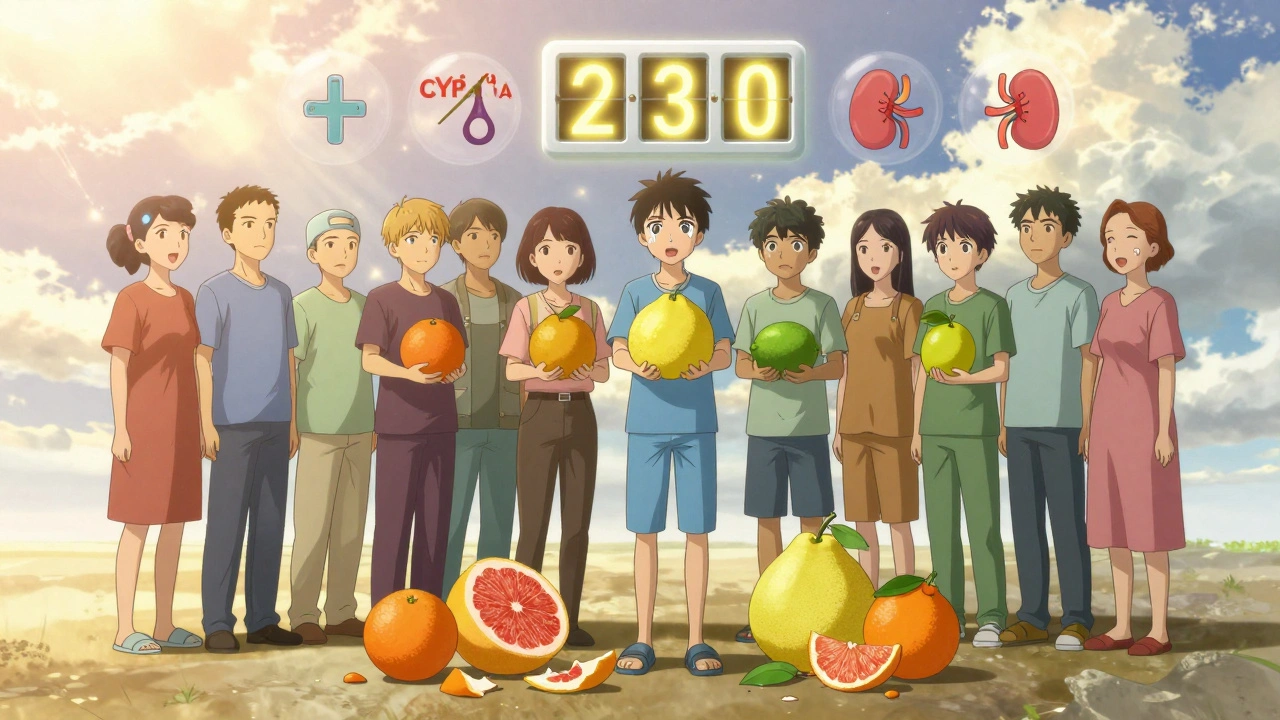
You can’t outsmart this interaction. You can’t time it. You can’t dilute it. You can’t make it safer with food. The only way to stay safe is to remove grapefruit, pomelo, and Seville oranges from your diet entirely. Not “sometimes.” Not “if I’m careful.” Not “I’ll just avoid it on medication days.” Your body doesn’t know the difference between one glass and ten. Your enzymes don’t recover fast enough. And your transplant doesn’t get a second chance. If you’re taking cyclosporine, tacrolimus, sirolimus, or everolimus, grapefruit is not a snack. It’s a risk. And the risk isn’t worth it.Can I drink orange juice instead of grapefruit juice?
Yes, regular sweet oranges, tangerines, lemons, and limes are safe. They don’t contain the furanocoumarins that cause the interaction. But avoid Seville oranges (bitter oranges), which are used in marmalade and can trigger the same dangerous effect as grapefruit.
How long after eating grapefruit is it safe to take my immunosuppressant?
It’s not safe to take your medication within 72 hours of consuming grapefruit. The enzyme inhibition lasts up to three days because the damage to CYP3A4 is irreversible. Your body needs that time to produce new enzymes. Even if you ate grapefruit two days ago, your drug levels could still be dangerously high.
Does grapefruit interact with all immunosuppressants?
No, only those metabolized by the CYP3A4 enzyme. The main ones are cyclosporine, tacrolimus, sirolimus, and everolimus. Drugs like mycophenolate (CellCept) and azathioprine (Imuran) are not affected. But never assume-always check with your pharmacist or transplant team.
What should I do if I accidentally eat grapefruit?
Contact your transplant team right away. Don’t wait for symptoms. You’ll likely need a blood test to check your drug levels. Your dose may be reduced temporarily, and you’ll need close monitoring. Even if you feel fine, the damage can be happening silently.
Are grapefruit supplements or extracts safe?
No. Supplements, extracts, and flavored products (like teas or yogurts) can contain concentrated furanocoumarins. These may be even more dangerous than fresh fruit or juice. Always read labels carefully and avoid anything with grapefruit, pomelo, or bitter orange listed as an ingredient.


just ate half a grapefruit this morning and took my tacrolimus 2 hours later… oops. i’m panicking. anyone else do this and live? my phone’s buzzing with the transplant nurse already.