
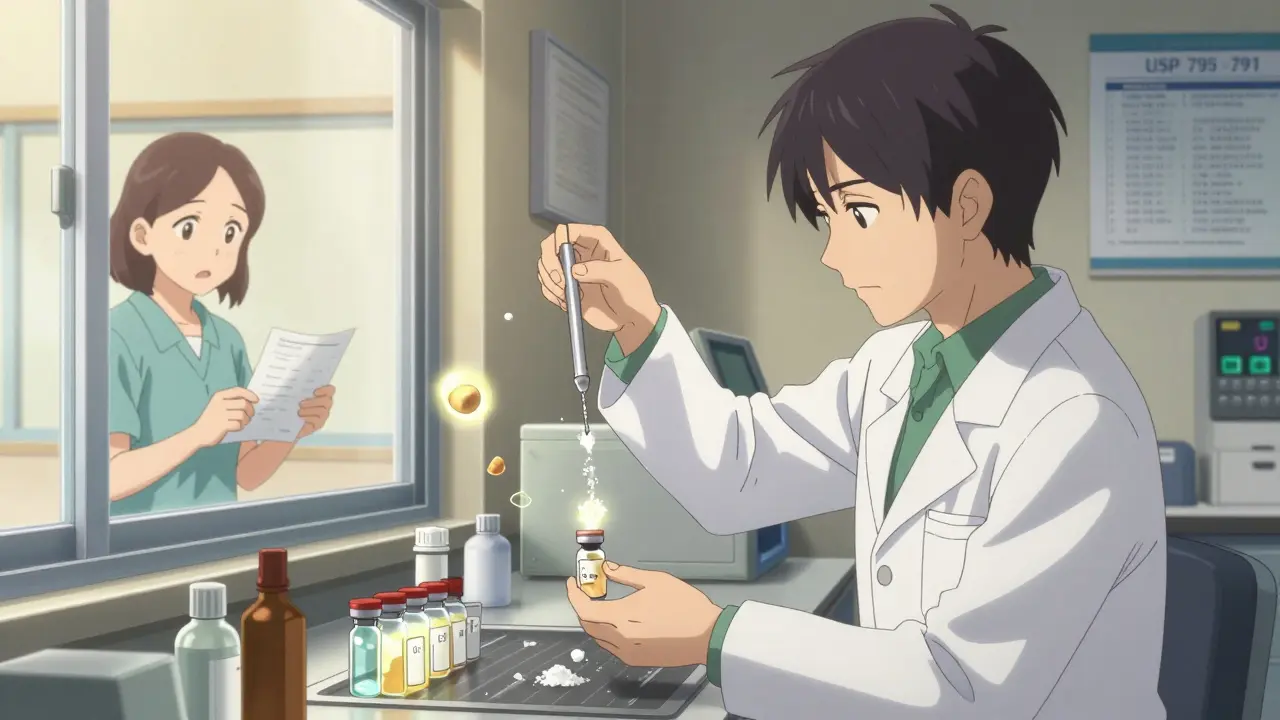
When your doctor prescribes a medication, but the pharmacy can’t fill it because of a shortage, what do you do? It’s not rare. In the U.S., there are 300 to 400 drug shortages every year, affecting everything from antibiotics to heart medications and even basic pain relievers. For many people, this isn’t just an inconvenience-it’s a health risk. That’s where compounding pharmacies come in.
What Exactly Is a Compounding Pharmacy?
A compounding pharmacy doesn’t just hand out pre-made pills from a shelf. It makes medications from scratch, mixing ingredients to match a patient’s exact needs. Think of it like a custom chef cooking a meal for someone with food allergies. Instead of serving a standard dish, they adjust the recipe to remove allergens, change the texture, or tweak the strength.
These pharmacies work under strict rules. In the U.S., they follow guidelines from the United States Pharmacopeia (USP), specifically USP <795> for non-sterile compounds and USP <797> for sterile ones. That means clean rooms, precise measuring tools, and trained pharmacists who double-check every batch. A typical compounding pharmacy might prepare a liquid version of a pill for someone who can’t swallow tablets, or a cream for a patient allergic to the dye in the commercial version.
According to the National Center for Biotechnology Information, about 7,500 U.S. pharmacies specialize in compounding, and another 32,000 offer some form of it. They’re not replacing regular pharmacies-they’re filling gaps that mass production can’t.
Why Do People Need Compounded Medications?
There are three big reasons people turn to compounding pharmacies when standard drugs aren’t available:
- Allergies or sensitivities: About 15-20% of people react to common fillers like lactose, gluten, dyes, or preservatives. A compounded version can remove these entirely. One patient on Reddit shared that switching from oral finasteride to a compounded topical version dropped their side effects from 32% to just 8%.
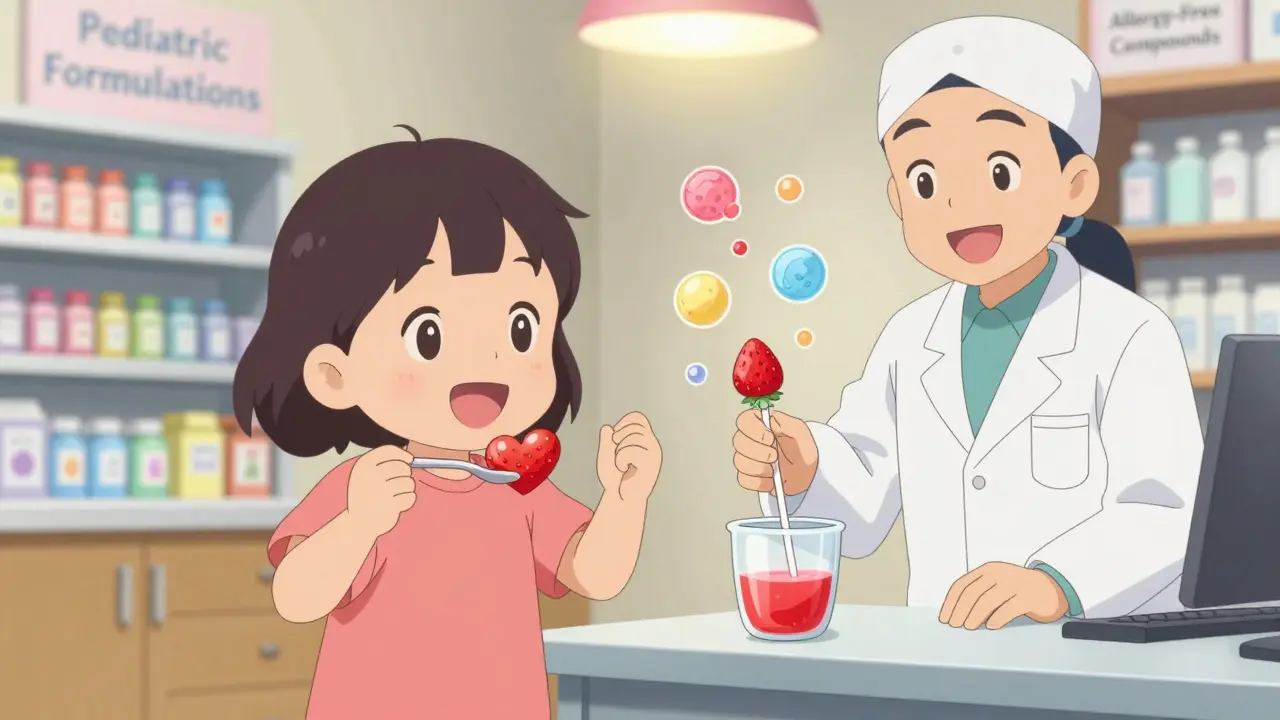
- Difficulty swallowing pills: Around 40% of children and 30% of older adults struggle with tablets or capsules. Compounding pharmacies can turn those into flavored liquids, gels, or even lollipops (called troches). Parents report a 73% increase in adherence when medications are flavored with strawberry or bubblegum.
- Need for specific dosages: Commercial drugs come in fixed strengths-5 mg, 10 mg, 20 mg. But some patients need 2.5 mg, or 7.8 mg. Compounding allows for microgram-level precision, which is critical for hormone therapies, pediatric dosing, or patients on multiple interacting drugs.
These aren’t edge cases. About 12% of compounded prescriptions are for kids, 28% for seniors, and 22% for allergy-sensitive patients. Hormone replacement therapy, pain management, and dermatology make up the largest categories of compounded prescriptions.
How Does It Work When a Drug Is Unavailable?
It starts with your doctor. They don’t just hand you a prescription for “compounded finasteride.” They first identify that the commercial version isn’t working-either because it’s out of stock, or because it’s causing side effects. Then they write a prescription that includes:
- The active ingredient
- The exact strength needed
- The desired dosage form (liquid, cream, capsule, etc.)
- Any exclusions (no lactose, no alcohol, no artificial colors)
From there, the prescription goes to a compounding pharmacy. The pharmacist reviews the formula, checks ingredient availability, and prepares the medication. Most take 24 to 72 hours to complete. Sterile compounds (like injections) take longer because they need extra testing to ensure safety.
Not all pharmacies do this. Only about 1,200 U.S. compounding pharmacies are accredited by the Pharmacy Compounding Accreditation Board (PCAB). That’s less than 16% of the total. If you’re using one, ask if they’re PCAB-accredited. It’s a sign they meet high standards for cleanliness, accuracy, and record-keeping.
What Can’t Compounding Pharmacies Do?
Compounding isn’t magic. It has limits.
They can’t make biologics-medications like insulin, monoclonal antibodies, or vaccines that come from living cells. These require complex manufacturing processes that no compounding lab can replicate. They also can’t make exact copies of brand-name drugs. If a generic version is available and safe, the FDA says you should use that instead.
Dr. Robert Smith from the National Community Pharmacists Association warns that 15% of compounded prescriptions could have been filled with existing FDA-approved drugs. Using compounding when it’s not necessary adds cost and risk. Compounded medications don’t go through the same pre-market testing as FDA-approved drugs. That means side effects or contamination can slip through.
That’s why the FDA calls compounding a “limited exception.” It’s meant for when there’s no other option-not as a workaround for convenience.
Cost and Insurance: The Hidden Challenge
Here’s the catch: most insurance plans don’t cover compounded medications the way they cover regular prescriptions. About 45% of patients pay out-of-pocket, compared to just 15% for standard drugs. A compounded version of a common drug can cost 3-5 times more.
Some insurers will cover it if the pharmacy submits documentation showing the commercial version isn’t suitable-like a letter from your doctor explaining your allergy or inability to swallow pills. But that process takes time. Many patients wait weeks just to get approval.
Still, the value is real. A 2022 survey by the International Academy of Compounding Pharmacists found that 89% of patients who rely on compounded meds would recommend them to others. Why? Because they work when nothing else does.
What’s Changing in the Industry?
The compounding market is growing fast. It was worth $11.2 billion in 2022 and is projected to hit $15.8 billion by 2027. Why? Two big reasons:
- Drug shortages keep getting worse
- More people want personalized medicine
Since the 2012 fungal meningitis outbreak tied to tainted compounded steroids, regulations tightened. The Drug Quality and Security Act of 2013 created two paths: 503A for traditional compounding pharmacies and 503B for larger outsourcing facilities that can supply hospitals.
New tech is helping too. Digital formulation tools have cut compounding errors by 37%. Better stability testing now extends shelf life by 25-40%. And more pharmacists are working with genetic test results to tailor doses-68% say demand for this is rising.
What Should You Do If a Drug Is Unavailable?
If your medication is out of stock, don’t panic. Talk to your pharmacist. Ask:
- Is there a generic version available?
- Can my doctor write for a compounded alternative?
- Does my pharmacy have a compounding partner I can use?
- Will my insurance cover it if I provide a medical necessity letter?
Don’t skip doses. Don’t split pills unsafely. Don’t try to substitute with something from the internet. A compounding pharmacist can help you navigate this. They’re trained to solve these exact problems.
And if you’re the one prescribing? Work with a compounding pharmacy you trust. Ask about their accreditation, their quality control process, and how they handle batch testing. This isn’t a backup plan-it’s a vital tool.
Final Thoughts
Compounding pharmacies aren’t the answer to every drug shortage. But for people with allergies, swallowing issues, or unusual dosage needs, they’re often the only answer. They bridge the gap between what’s mass-produced and what’s medically necessary.
The system isn’t perfect. Costs are high. Insurance is patchy. But for thousands of patients, these pharmacies mean the difference between managing a condition and not being able to treat it at all.
If you’ve ever been told, “We don’t have that,” and then found a solution through a compounding pharmacy-you’re not alone. And you’re part of a growing movement toward personalized, patient-centered care.
Are compounded medications safe?
Yes, when made by an accredited pharmacy following USP guidelines. Compounded drugs don’t go through FDA pre-market approval, but they are held to strict quality standards. Look for PCAB accreditation, which means the pharmacy has passed independent audits for cleanliness, accuracy, and record-keeping. Avoid pharmacies that don’t disclose their sourcing or testing practices.
Can any pharmacy compound medications?
Technically, yes-but not all should. Only about 1,200 of the 7,500 compounding pharmacies in the U.S. are accredited by the Pharmacy Compounding Accreditation Board (PCAB). Most community pharmacies offer minimal compounding, like flavoring pills. For complex or sterile preparations, use a specialized compounding pharmacy with proven experience and accreditation.
How long does it take to get a compounded prescription?
Most take 24 to 72 hours. Simple non-sterile compounds (like creams or flavored liquids) can be ready in a day. Sterile preparations-like injections or IV solutions-require extra testing and can take up to 5 days. Always ask the pharmacy for a timeline when you submit the prescription.
Why won’t my insurance cover compounded drugs?
Most insurance plans only cover FDA-approved drugs because they’ve been tested for safety and effectiveness. Compounded drugs are considered custom-made and aren’t pre-approved. Some insurers will cover them if your doctor submits a letter of medical necessity explaining why the commercial version won’t work. Always check with your insurer before proceeding.
Can compounding pharmacies make any drug I need?
No. They can’t make biologics like insulin, vaccines, or monoclonal antibodies. They also can’t replicate complex drug delivery systems like extended-release capsules or transdermal patches with precise absorption profiles. Compounding works best for simple formulations: liquids, creams, capsules, and troches. If your medication requires advanced manufacturing, you’ll need to wait for the commercial version to return.


Let me tell you something nobody else will
Compounding pharmacies aren't some hippie fantasy-they're the only reason my kid still gets his seizure meds when Big Pharma decides to 'optimize supply chains' and drop 80% of the market
My daughter can't swallow pills. She's 7. The commercial version had red dye that made her break out like a horror movie
Compounded? Flavorless liquid. No gluten. No lactose. No nonsense
Took 48 hours. Cost $120. Insurance? Nope
Would I do it again? In a heartbeat. They saved her life. And yes, I know you're gonna say 'but FDA'-shut up. She's alive. You're not.
End of story.