

When your kidneys fail, life doesn’t stop-but how you manage it changes completely. Two main treatments keep people alive: hemodialysis and peritoneal dialysis. Both remove waste and extra fluid from your blood. But they work in totally different ways, and the choice isn’t just medical-it’s personal.
How Hemodialysis Works
Hemodialysis uses a machine to clean your blood outside your body. You’re hooked up to it through a needle in your arm, usually at a clinic three times a week. Each session lasts about 3 to 5 hours. Blood flows out through one tube, into the dialysis machine, where it’s filtered through a special membrane, then returned to your body.To make this work, doctors need a strong access point. Most patients get an arteriovenous (AV) fistula-a connection between an artery and vein in the arm. It takes 6 to 8 weeks to heal and mature before it can be used. Some get a graft if their veins are too small. Others start with a central venous catheter, but that’s riskier and usually temporary.
The machine pulls blood at 300-500 mL per minute. That’s fast. It clears toxins quickly, which is great for people with sudden kidney failure or severe fluid overload. But that speed comes at a cost. Many patients feel drained, nauseous, or crampy after a session. Blood pressure can crash. The body doesn’t get time to adjust slowly.
How Peritoneal Dialysis Works
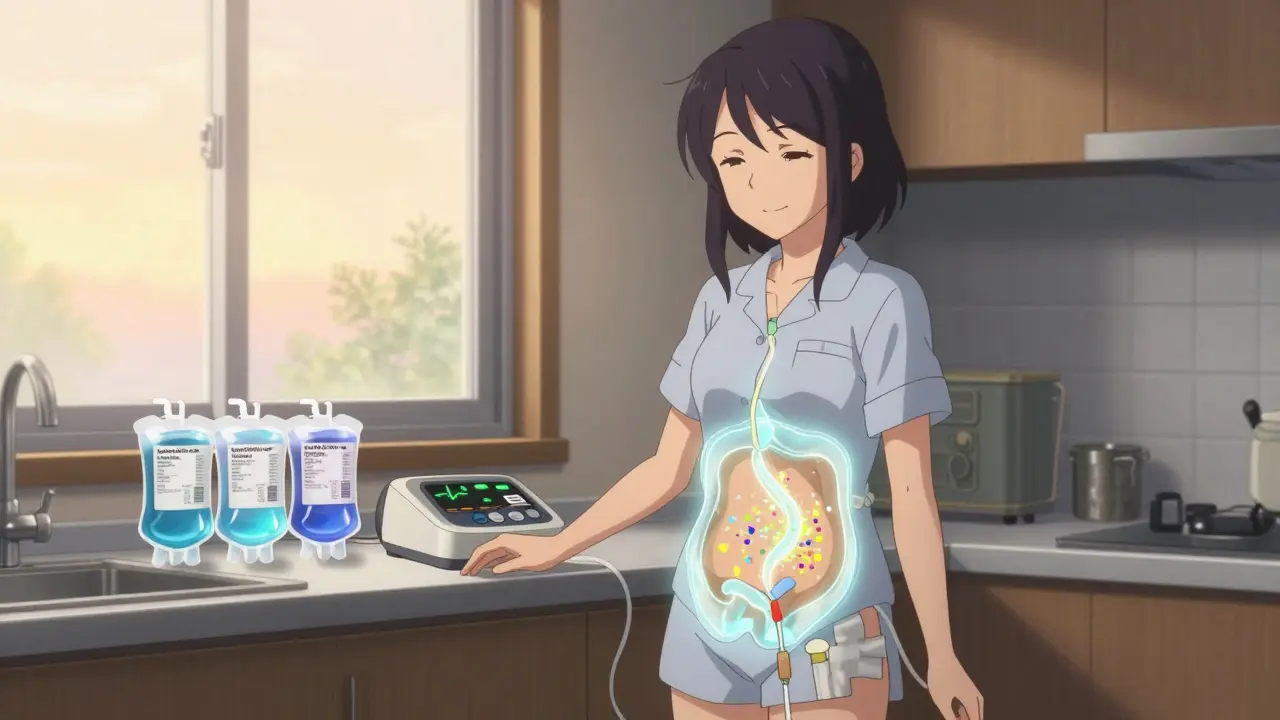
Peritoneal dialysis (PD) uses your own belly lining-the peritoneum-as a natural filter. A soft tube, called a Tenckhoff catheter, is surgically placed in your abdomen. It stays there permanently. You fill your belly with dialysis fluid, let it sit for 4 to 6 hours, then drain it out. The fluid pulls waste and extra water through your peritoneal membrane.There are two types. Continuous Ambulatory Peritoneal Dialysis (CAPD) means you do 3 to 5 exchanges by hand every day. Automated Peritoneal Dialysis (APD) uses a machine at night while you sleep. You connect to a cycler, and it does the work for you. You wake up with clean fluid out and fresh fluid in.
PD doesn’t need a machine during the day for CAPD. For APD, you only need the cycler, a few bags of fluid, and space to store them. No needles in your arm. No trips to a clinic three times a week. You can do it at home, while working, or even traveling.
Which One Clears Toxins Better?
At first glance, hemodialysis looks stronger. It removes more waste in one session. The Kt/V measure-a standard for dialysis efficiency-hits 1.2 to 1.4 per session for HD. PD doesn’t clear as much in a single exchange. But PD runs 24/7. Over a week, the total clearance (weekly Kt/V) is 1.7 to 2.1. That’s actually higher than what most HD patients get across three sessions.Studies show PD handles potassium, sodium, and fluid better between treatments. That means fewer spikes in blood pressure and less strain on your heart. A 2023 study from First People’s Hospital of Tonglu County compared 77 PD patients to 74 HD patients. PD group had significantly lower systolic and diastolic blood pressure. Their heart rate stayed steadier. Their parathyroid hormone levels dropped more, which helps protect bones.
HD clears toxins fast, but it’s like a sledgehammer. PD is like a slow drip. For many, the slow drip feels better.
Complications: Risks You Can’t Ignore
No dialysis is risk-free. But the risks are different.With hemodialysis, the biggest danger is your access point. AV fistulas can clot or get infected. Catheters are even worse-they’re the leading cause of bloodstream infections in dialysis patients. About 1 in 5 HD patients get a serious infection each year. And every session can cause low blood pressure, heart rhythm problems, or muscle cramps.
Peritoneal dialysis has one main enemy: peritonitis. That’s an infection in your belly from bacteria getting in through the catheter. Rates are low-0.3 to 0.7 episodes per patient per year-but one infection can mean hospitalization and even switching to HD. It’s why sterile technique matters so much. You have to wash your hands, wear a mask, and clean the connection every time you swap fluid.
PD also isn’t for everyone. If you’ve had major abdominal surgery, have severe obesity (BMI over 35), or can’t handle the manual work due to arthritis or vision problems, PD might not work. HD doesn’t care about your belly-it cares about your veins.
Quality of Life: Flexibility vs. Routine
This is where many patients make their choice.HD means fixed appointments. Three times a week. Every week. No skipping. You’re tied to a clinic schedule. Many say they feel wiped out for hours after. Some miss work. Others can’t travel far. A Reddit survey of 142 HD users found 97% complained about the rigid schedule. 83% said they felt exhausted after treatment.
PD gives you freedom. You control the timing. You can do exchanges during lunch, after school, or while watching TV. APD lets you sleep through it. A 2022 National Kidney Foundation survey found 68% of PD users rated their flexibility higher than HD users. That’s huge for people who work, care for kids, or want to live more normally.
But PD demands more responsibility. You’re doing the treatment yourself. You need to learn sterile technique. You need to store dialysis fluid. You need to track your exchanges. If you forget or mess up, you risk infection. For some, that’s too much. For others, it’s worth it.
Cost and Accessibility
In the U.S., 70% of dialysis patients use HD. Only 12% use PD. Why? Infrastructure. Most clinics are built for HD. Machines, staff, space-it’s all designed for in-center care.But PD is cheaper. A 2023 study in the Journal of Peritoneal Therapy and Clinical Practice found PD offers better value for money. Less need for hospital visits. Fewer complications over time. Lower nursing costs. The Centers for Medicare & Medicaid Services (CMS) now incentivizes home dialysis. Their goal? 80% of new dialysis patients get educated about home options by 2025.
Geographic differences tell a story. In Hong Kong, 77% of patients use PD. In the U.K., it’s 22%. In the U.S., it’s 12%. Why? Training. Only 34% of U.S. nephrology fellows get proper PD training. Many doctors still think PD is outdated. But evidence says otherwise. The American Journal of Kidney Diseases predicts PD use in the U.S. will rise to 18-22% by 2027.

Who Should Choose What?
There’s no single right answer. But here’s what experts agree on:- Choose hemodialysis if you have unstable blood pressure, severe heart disease, or need rapid fluid removal. It’s also better if you can’t manage daily care, have abdominal scarring, or prefer professionals handle your treatment.
- Choose peritoneal dialysis if you’re medically stable, want independence, can follow a routine, and don’t have abdominal issues. It’s ideal for younger patients, those with jobs, or people who hate frequent clinic visits.
Some patients start with HD and switch to PD. Others begin with PD and move to HD if they get infections. It’s not a life sentence. You can change.
What’s Changing in 2025?
New dialysis fluids are making PD safer. Icodextrin solutions last longer and don’t damage the peritoneal membrane like glucose-based fluids. Glucose-sparing regimens are reducing diabetes risk in PD patients.Home hemodialysis is growing too. More people are using machines at home, five or six times a week, for shorter sessions. That’s gentler on the body. But it needs space, water filtration, and training.
The trend? Personalization. Doctors are moving away from one-size-fits-all. They’re asking: What’s your lifestyle? Your support system? Your ability to manage care? Your goals?
There’s no best option. Just the best option for you.
Can I switch from hemodialysis to peritoneal dialysis?
Yes, many patients switch. If you’re tired of clinic visits and your belly is healthy, PD can be a good option. Your doctor will check for abdominal scarring, infection history, and your ability to manage daily exchanges. Switching takes planning, but it’s common and safe.
Is one dialysis type better for long-term survival?
Studies show no clear survival advantage between hemodialysis and peritoneal dialysis over the long term. Both can keep you alive for years. What matters more is how well you tolerate the treatment, how well you stick to your plan, and whether you avoid complications. PD may protect your remaining kidney function better, which can improve long-term outcomes.
Does peritoneal dialysis hurt?
The catheter placement is done under local or general anesthesia, so you won’t feel pain during surgery. Afterward, there’s some soreness for a few days. Once healed, exchanges usually cause mild pressure or fullness, not pain. Some people feel a slight tug when draining fluid, but it’s rarely painful. If you feel sharp pain during exchanges, contact your care team-it could be a sign of infection or a problem with the catheter.
Can I travel with peritoneal dialysis?
Yes, many people travel with PD. For CAPD, you carry dialysis fluid in insulated bags. For APD, you can bring your cycler on flights (with airline approval). Dialysis centers worldwide can often supply fluid if you’re traveling. Some patients even use PD while camping or on road trips. Planning ahead is key-always check local suppliers and pack extra supplies.
Why isn’t peritoneal dialysis more common if it’s better?
It’s not more common because of history, not science. Hemodialysis was easier to set up in clinics decades ago. Doctors were trained on HD. Insurance systems were built around it. Even today, many nephrologists don’t get enough PD training. Patients are often offered HD first, without being told about PD options. That’s changing, slowly. More patients are asking for home therapies-and that’s pushing the system to adapt.
What Comes Next?
If you’re facing dialysis, don’t rush. Talk to your nephrologist. Ask for a PD consultation-even if you think HD is your only option. Ask about home dialysis programs. Ask about training. Ask what your chances are of keeping your own kidney function longer.Most people don’t realize they have choices. But you do. The goal isn’t just to survive. It’s to live-on your terms.


It’s funny… I used to think dialysis was just a machine thing-until my cousin started PD. Now I see it’s not about technology. It’s about rhythm. Hemodialysis is like being punched in the gut every three days. PD? It’s like breathing. You don’t notice it… until you realize you’ve been living without screaming.