
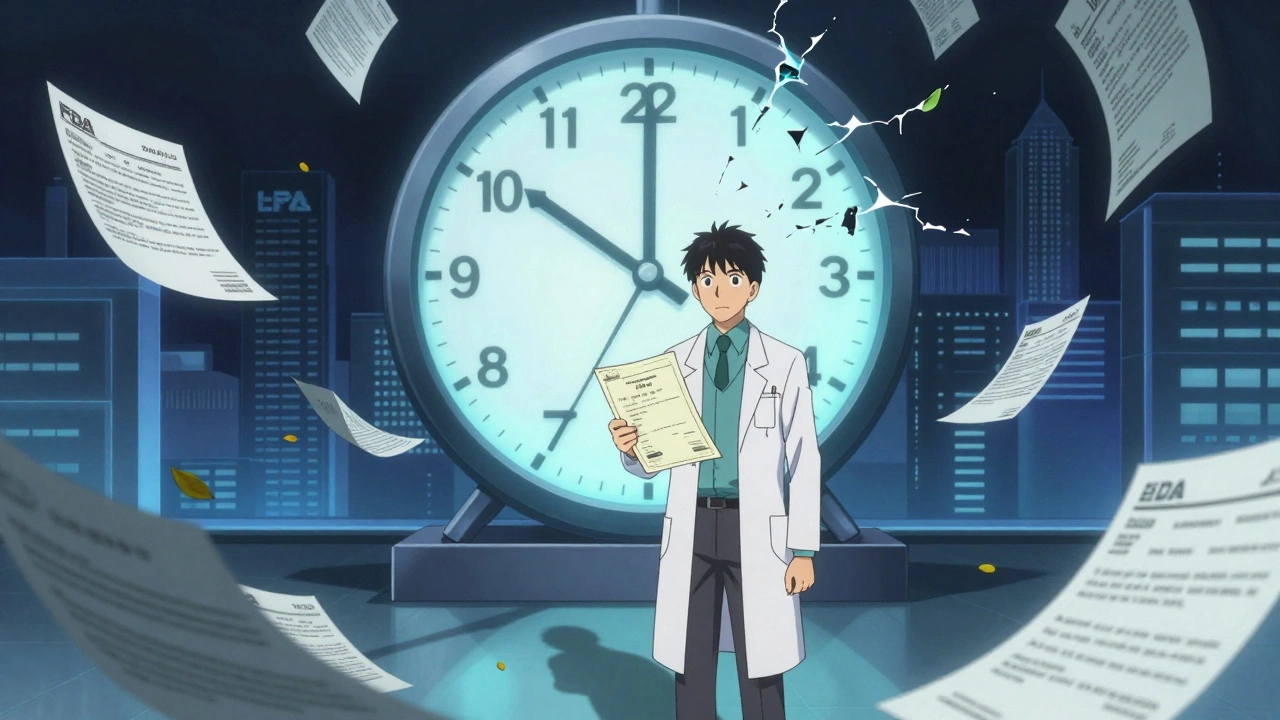
Imagine spending 12 years and $2 billion to develop a new cancer drug-only to find out you have less than five years left on your patent after FDA approval. That’s the reality for many pharmaceutical companies. Patent term restoration exists to fix that imbalance. It’s not a loophole. It’s a legal tool built into U.S. law to make up for time lost during regulatory review. Without it, drug innovation would slow down dramatically.
How Patent Term Restoration Works
Patent term restoration (PTR), also called patent term extension (PTE), lets drug and medical device makers get back some of the 20-year patent life they lose waiting for FDA approval. The clock starts ticking the moment a patent is issued. But for most drugs, the real race begins when a company files its Investigational New Drug (IND) application. From there, clinical trials, data collection, and FDA review can take 7 to 10 years. By the time the drug hits the market, half the patent is already gone.
The Hatch-Waxman Act of 1984 created PTR to balance two goals: letting generics enter the market faster, while still giving innovators enough time to recoup their investment. The law says you can get back up to five years of patent life-but only if you meet strict rules. The extension is calculated as half the time spent in clinical testing, plus all the time spent in FDA review. But there’s a cap: the total patent life after extension can’t go beyond 14 years after FDA approval.
For example, if a drug took 6 years to complete clinical trials and 3 years to get approved, the extension would be 3 years (half of 6) plus 3 years (review time) = 6 years. But since the law caps it at 5 years, the company gets 5. If the drug was approved 16 years after the patent was issued, the remaining patent life would be 4 years. After restoration, it becomes 9 years.
Who Qualifies for Patent Term Restoration?
Not every patent qualifies. The law only covers products that need FDA approval: human drugs, medical devices, food additives, color additives, and animal drugs. The patent must claim the product itself, a method of using it, or a manufacturing process. And crucially, the patent must be in force when the product gets approved.
Here’s the catch: only one patent per product can be extended. If a company holds five patents covering the same drug, they have to pick just one. That’s why companies spend years strategizing which patent to target. Often, they’ll file multiple patents with overlapping claims-some for the molecule, others for formulations, dosages, or methods of use-so they have options when the time comes.
Patents issued before 1984 are limited to a maximum 2-year extension, thanks to a 1996 court ruling. And if the patent holder didn’t act with “due diligence” during testing-like dragging their feet on clinical trials-the FDA can cut the extension or deny it entirely. There have been cases where extensions were slashed from 14 months to just 2 months because of delays in patient recruitment.
Patent Term Restoration vs. Data Exclusivity
Many people confuse PTR with data exclusivity, but they’re totally different. PTR extends the actual patent. Data exclusivity is a separate FDA rule that blocks generic companies from using the innovator’s clinical trial data to get approval-even if the patent has expired.
For new chemical entities, data exclusivity lasts 5 years. For new clinical studies on existing drugs, it’s 3 years. Orphan drugs get 7 years. These protections kick in automatically. No application needed. But they don’t stop generics from making the drug. They just can’t copy the original data to prove safety and effectiveness.
Patent term restoration, on the other hand, lets the patent holder sue generics for infringement during the extended period. It’s stronger legal protection. That’s why 87% of the top 100 selling drugs in 2022 used PTR to extend exclusivity. Data exclusivity helps, but PTR is the real money-maker.

The Application Process: Timing Is Everything
The clock starts ticking the day the FDA approves the drug. You have exactly 60 days to file a PTR application with the FDA. Miss that window, and you lose your chance forever. According to FDA data, 37% of denied PTR applications were because companies filed too late.
The application isn’t simple. You have to identify the exact patent you’re extending, specify which claims cover the approved product, and prove the product was subject to regulatory review. The FDA then calculates the regulatory review period and publishes it in the Federal Register. Third parties have 60 days to challenge the calculation. If someone claims you weren’t diligent during testing, they can file a due diligence petition. These challenges are growing-up 22% between 2018 and 2022.
After the FDA’s calculation, the USPTO reviews the application and issues the actual extension. The whole process takes 6 to 12 months. First-time applicants make mistakes in 42% of cases. Common errors include misidentifying patent claims, miscalculating testing phases, or missing required documentation. That’s why big pharma companies hire dedicated PTR specialists-usually lawyers with JD/PhD backgrounds and at least five years of experience.
Why PTR Matters for Innovation
Without patent term restoration, drug development would be far riskier. The average time from IND to approval is 8.2 years. That means most drugs enter the market with less than 12 years of patent life left. For a drug that costs $2 billion to develop, that’s not enough time to make a profit.
Research from Duke University shows PTR increases the net present value of drug development by 11% to 15%. The Congressional Budget Office estimates PTR extensions cost Medicare $5.2 billion a year by delaying generics. But the trade-off is innovation. PhRMA says without PTR, ROI on new drugs would drop by 18%, making many projects unviable.
That’s why 95% of novel drugs approved between 2015 and 2022 got at least one patent extended. Small-molecule drugs have a 98% extension rate. Biologics are lower at 82%, but rising. Combination products-like drug-eluting stents or inhalers with built-in sensors-are seeing a 300% spike in PTR applications since 2015.
Controversies and Criticisms
Not everyone sees PTR as fair. Critics say it’s used for “evergreening”-making tiny changes to a drug just to reset the clock. The FTC found 12% of PTR applications between 2015 and 2019 involved “product hopping,” where companies switched from a tablet to a capsule or added a new coating to trigger a new regulatory review period.
Some lawmakers have tried to cap extensions at 3 years. The “Lower Drug Costs Now Act” proposed that in 2021, but it didn’t pass. Still, pressure is growing. With drug prices under scrutiny and Medicare spending rising, PTR is under fire. But the industry argues that without it, fewer new drugs would be developed, especially for rare diseases or cancers.
One big legal question looms: will the Supreme Court ever rule PTR unconstitutional? The 2021 Amgen v. Sanofi decision raised concerns about how broadly patents can cover biological drugs. If future rulings limit patent scope, PTR could become harder to apply.
What’s Next for Patent Term Restoration?
As drug development takes longer, PTR will become even more important. Oncology and orphan drugs are the fastest-growing segments for PTR applications, projected to grow 22% per year through 2027. Electronic filing, required since January 2023, has cut processing time from 90 to 60 days. Tools like Patexis PTR Calculator help reduce errors by 78%.
But the real challenge isn’t technical-it’s political. As generic drug makers push harder for faster market entry, and as public pressure mounts over drug prices, PTR could face new limits. For now, it remains a cornerstone of pharmaceutical IP strategy. Companies that understand it, plan for it, and execute it well keep their products protected. Those who don’t? They lose years of exclusivity-and billions in potential revenue.
Can any patent be extended under patent term restoration?
No. Only patents covering products that require FDA approval-like human drugs, medical devices, or animal drugs-are eligible. The patent must be active at the time of approval and must claim the product, its use, or its manufacturing method. Patents for unrelated inventions, like software or industrial processes, don’t qualify.
How long do I have to apply for patent term restoration after FDA approval?
You have exactly 60 days from the date of FDA approval to file your application. Missing this deadline means you lose the right to extension permanently. This is the most common reason applications are denied.
Can I extend more than one patent for the same drug?
No. Only one patent per approved product can be extended, even if the company holds multiple patents covering the same drug. Companies must choose the strongest or most strategically valuable patent to extend. This is why patent portfolios are carefully structured years before approval.
What happens if the FDA says I didn’t act with due diligence?
If a third party files a due diligence petition and proves you delayed clinical trials or regulatory submissions without good reason, the FDA can reduce or deny your extension. This has happened in multiple cases, with extensions cut from over a year down to just months. Meticulous record-keeping of all regulatory interactions is essential.
Does patent term restoration apply to biologics?
Yes, but less frequently than for small-molecule drugs. Biologics are eligible for PTR, but only 82% receive extensions compared to 98% for traditional drugs. This is partly because biologics often have more complex patent landscapes and face different regulatory pathways. However, PTR use for biologics is growing rapidly.


This hit me hard-I have a family member who relied on a drug that only became available because of PTR. Without it, they might not be here today. 🥺