
When you're managing an autoimmune disease like rheumatoid arthritis, psoriasis, or Crohn’s disease, biologics can be life-changing. These targeted drugs-monoclonal antibodies, fusion proteins, and other immune-modulating agents-work by shutting down specific parts of your overactive immune system. But that same power comes with a serious trade-off: a significantly higher risk of infections. The data is clear. Patients on biologics face a 2.1 times higher risk of being hospitalized for infections compared to those on traditional treatments. This isn’t a rare side effect-it’s a predictable outcome built into how these drugs work.
Why Biologics Increase Infection Risk
Biologics don’t just calm down inflammation-they suppress your body’s ability to fight off germs. The biggest culprits are TNF inhibitors like adalimumab (Humira) and infliximab (Remicade). These drugs block tumor necrosis factor, a key protein your immune system uses to signal infection. Without it, even common bacteria and viruses can slip through unnoticed. Studies show TNF inhibitors carry a 1.6 to 1.9 times higher risk of serious infections than non-TNF biologics like ustekinumab (Stelara) or secukinumab (Cosentyx). And while newer agents are generally safer, they aren’t risk-free. IL-17 inhibitors, for example, increase the chance of fungal infections like candidiasis. JAK inhibitors like tofacitinib raise the risk of shingles by 1.33 times.The danger isn’t just about the drug itself. It’s about what’s already inside you. Latent infections like tuberculosis (TB) or hepatitis B can wake up when your immune system is suppressed. In fact, without proper screening, 27.6% of patients with hidden hepatitis B will reactivate after starting a biologic. That’s not a small chance-it’s a medical emergency waiting to happen.
Screening Before You Start: What You Must Get Tested For
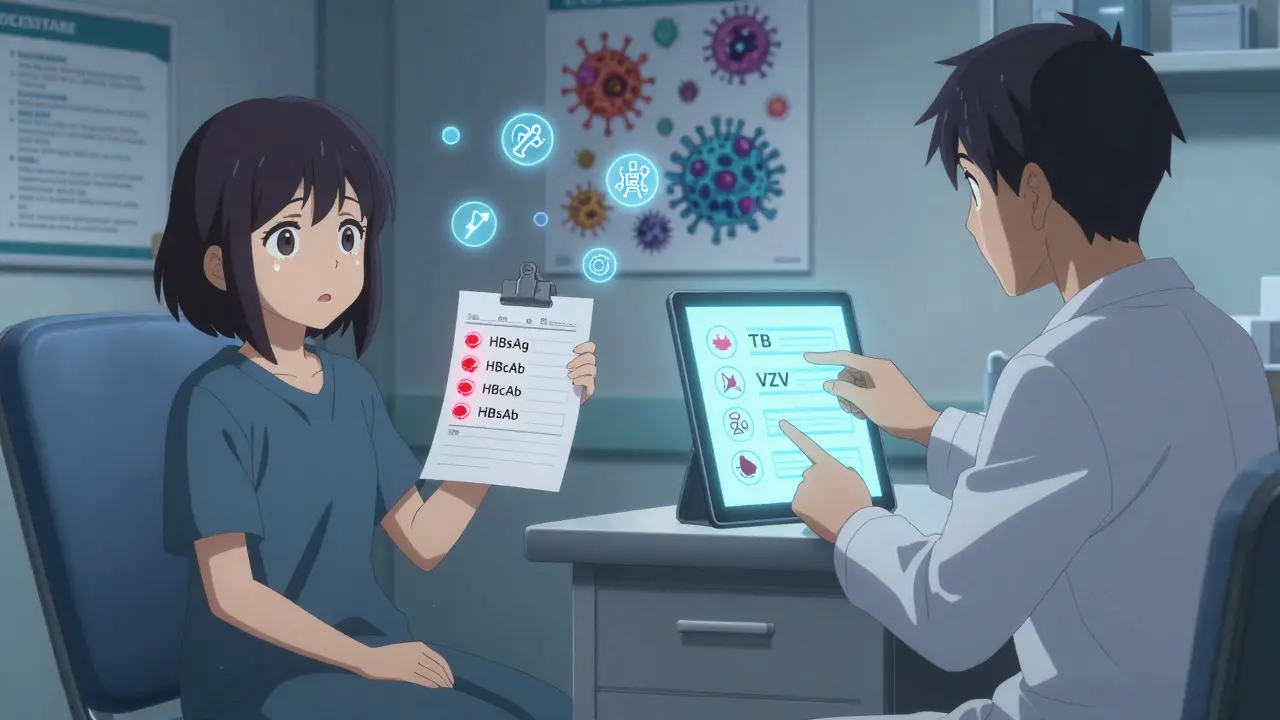
Before your first biologic dose, you need a full infection risk assessment. This isn’t optional. It’s standard of care, backed by the CDC, FDA, and the American College of Rheumatology. Here’s what you must have done:- HBV screening: Three blood tests-HBsAg, HBsAb, and HBcAb. If HBcAb is positive (even if HBsAg is negative), you need a follow-up HBV DNA test. Occult hepatitis B is real, and it affects 8.7% of people in this group.
- Tuberculosis screening: Either a skin test (TST) or interferon-gamma release assay (IGRA). IGRA is more specific and preferred. A positive result doesn’t mean you can’t take biologics-it means you need TB treatment first.
- Hepatitis C and HIV: Routine testing is recommended, though these don’t always block biologic use.
- Varicella-zoster virus (VZV) serology: If you don’t remember having chickenpox or the vaccine, get tested. IgG levels below 140 mIU/mL mean you’re not protected.
Skipping even one of these tests puts you at risk. Real-world data from patient forums shows that 41% of screening omissions involve HBV core antibody testing, and 37% miss VZV checks. That’s not negligence-it’s a preventable disaster.
Vaccination Timing: Do This Right, or It Won’t Work
Vaccines are your first line of defense-but only if given at the right time. Once you start a biologic, your immune system can’t respond properly to live vaccines. That’s why timing matters more than the shot itself.- Live vaccines (MMR, varicella, nasal flu): Must be given at least 4 weeks before your first biologic dose. If you wait until after, they’re unsafe.
- Inactivated vaccines (flu shot, pneumococcal, hepatitis B, tetanus): Can be given at least 2 weeks before starting. Some providers give them on the same day as screening-this is acceptable if done early enough.
- Shingrix (shingles vaccine): This is critical. Two doses, 2-6 months apart. Get it done before biologics. If you get shingles after starting, your risk of complications skyrockets.
And don’t assume your childhood vaccines are enough. Many adults lose immunity over time. For hepatitis B, you need to confirm protection with a blood test. Anti-HBs levels must be at least 10 mIU/mL. If not, you need a full booster series. For VZV, IgG must be ≥140 mIU/mL. No guesswork. No assumptions.

Who’s at Highest Risk?
Not everyone on biologics gets sick. But some people are far more vulnerable. Your risk isn’t just about the drug-it’s about your whole health picture.- Age over 50: Each decade past 50 increases infection risk by 37%.
- High-dose steroids: Taking more than 10 mg of prednisone daily multiplies your risk by 2.3 times.
- Diabetes: Odds ratio of 1.89 for serious infection.
- Chronic kidney disease: Odds ratio of 2.15.
- COPD: Odds ratio of 2.41.
If you have even one of these, your doctor should be extra cautious. You may need a different biologic, longer screening, or even prophylactic antibiotics or antivirals. For example, patients with hepatitis B history may be started on antiviral drugs like entecavir before biologics even begin.
What Happens When Screening Is Skipped
Real stories tell the truth. One patient on HealthUnlocked shared: “My GI doctor started Stelara without checking my vaccines. I got shingles four months later.” Another on MyTherapy said: “Mayo Clinic caught my latent TB. We treated it for 9 months. Since starting Humira, I’ve had zero infections.”These aren’t outliers. A 2023 survey of over 2,100 patients found that those who received full education-including the CDC’s 12-point checklist-had a 78% rate of zero serious infections. Those who didn’t? Only 43%. The difference isn’t luck. It’s protocol.
And the system is failing. CMS audits show that 23.7% of clinics don’t keep screening records for the required 10 years. Rural clinics complete only 28% of critical screenings. That’s not just poor care-it’s a public health gap.

What’s Changing in 2025 and Beyond
The rules are tightening. In February 2025, the FDA issued draft guidance requiring real-world evidence of infection control for any new biologic label expansion. That means drugmakers now have to prove they’ve reduced infection rates-not just claimed it.The CDC’s upcoming BMBL 7th Edition (coming October 2025) will include specific biologics safety protocols, including how long pathogens survive on surfaces and what personal protective equipment is needed during handling. Insurance companies are catching up too. Starting in 2026, CMS will tie 15% of biologic payments to documented infection risk mitigation. That’s going to force clinics to get serious.
Tools are improving. AI models like the Cerner Biologics Safety Algorithm now predict individual risk scores using 87 clinical variables. In trials, it hit an AUC of 0.87-meaning it’s highly accurate. These tools won’t replace doctors, but they’ll help them make smarter calls.
Your Action Plan
If you’re considering a biologic-or already on one-here’s what to do next:- Request full infection screening: HBV (all three markers), TB (IGRA), VZV IgG, and hepatitis C/HIV.
- Review your vaccine history. If you’re unsure about chickenpox or shingles, get tested-not just a shot.
- Get Shingrix, pneumococcal, and flu vaccines at least 2-4 weeks before starting.
- Ask if you need antiviral prophylaxis (especially if you have hepatitis B history or are on TNF inhibitors).
- Keep copies of all screening results and vaccination records. Store them digitally and physically.
- Don’t wait for your doctor to bring it up. Be the one who asks.
Biologics are powerful. But they’re not magic. Their safety depends on you, your team, and the steps you take before the first dose. The data doesn’t lie: thorough screening and vaccination cut infection rates by over 30%. That’s not just a number-it’s a chance to live longer, healthier, and without hospital stays.


Screening isn't optional. Period. If your doctor skips HBV core antibody testing, find a new one. I've seen two patients reactivate hepatitis B on Stelara because their clinics cut corners. It's not about fear-it's about basic medical hygiene.