

LDL Reduction Calculator
Discover how combination therapy can lower LDL more effectively than higher statin doses alone. Based on clinical evidence from over 20,000 patients.
Choose Approach:
Enter your current LDL level to see results
For years, doctors have reached for higher doses of statins when patients’ LDL cholesterol won’t drop low enough. But what if doubling the statin dose doesn’t double the results? And what if that higher dose makes you feel worse-muscle aches, fatigue, even quitting the drug entirely? There’s a better way, and it’s not about pushing statins harder. It’s about combining them smarter-with lower doses and other proven medications.
Why Higher Statin Doses Don’t Work Like You Think
The idea that more statin equals better results sounds logical. But it’s not how the body responds. Research shows a hard limit: each time you double the statin dose, you only get about 6% more LDL reduction. That’s called the ‘rule of six.’Take atorvastatin. At 10 mg, it lowers LDL by around 39%. Double it to 20 mg? You get 45%. Not 78%. Not even 50%. Just 6% more. Go from 40 mg to 80 mg? You might get one more 6% bump. That’s it. Meanwhile, your risk of muscle pain, liver issues, or just feeling awful goes up.
Doctors used to think: ‘If 40 mg isn’t enough, try 80.’ But now we know: that’s not the best path. It’s like turning up the volume on a speaker that’s already maxed out-noisy, strained, and not much louder.
The Real Game-Changer: Adding a Second Drug
Instead of pushing statins higher, doctors are now adding a second, non-statin drug at the same time. This isn’t experimental. It’s backed by over 40 major clinical trials involving nearly 20,000 people.The most common combo? A moderate statin (like atorvastatin 20 mg or rosuvastatin 10 mg) plus ezetimibe (10 mg). Together, they cut LDL by 50-55%. That’s better than high-dose statin monotherapy, which maxes out at 50%.
How does that work? It’s not simple addition. It’s multiplication. Think of it this way: if a statin cuts LDL by 50%, that leaves 50% still in your blood. Ezetimibe then cuts 20% of that leftover 50%-adding another 10% total. So 50% + 10% = 60%. That’s why combining drugs works better than pushing one drug too hard.
Who Benefits Most From This Approach?
This isn’t for everyone. But if you fall into one of these groups, combination therapy could be life-changing:- You’ve had a heart attack or stroke
- You have diabetes plus high cholesterol
- You have familial hypercholesterolemia (inherited very high LDL)
- You’ve tried high-dose statins and stopped because of side effects
- Your LDL is still above 70 mg/dL after statin therapy
In these cases, guidelines now say: don’t wait. Start with combination therapy. Why? Because the goal isn’t just to lower LDL-it’s to lower it fast and keep it low. Every 1 mmol/L (39 mg/dL) drop in LDL means a 22% lower risk of heart attack or death. That’s true no matter how you get there.
Real-World Results: Numbers That Matter
A 2024 study tracking over 5,000 high-risk patients found something striking:- With statin alone: 62.3% reached target LDL
- With statin + ezetimibe: 78.5% reached target
That’s a 16% absolute improvement. More people hit their goal. Fewer had another heart event.
And the side effects? Big win. High-dose statins cause muscle pain in 10-15% of people. Moderate-dose statins? Only 5-8%. Add ezetimibe, and you keep the benefit without the muscle aches. In one study, patients who switched from high-dose statin to moderate statin + ezetimibe stayed on therapy 85% of the time after one year. Those who kept trying high-dose statins? Only 50% stuck with it.

Other Options Beyond Ezetimibe
Ezetimibe isn’t the only option. If you can’t tolerate statins at all, bempedoic acid is another tool. It lowers LDL by about 18% and causes 25% fewer muscle problems than high-dose statins. Combine it with a low-dose statin, and you get the same LDL drop as a high-dose statin-without the side effects.For those who need even more-like someone with multiple heart attacks or inherited cholesterol disease-PCSK9 inhibitors (injections like evolocumab or alirocumab) can cut LDL by 60%. Used with a moderate statin and ezetimibe, you can get an 84% drop. That’s powerful. But cost and access remain barriers.
Why Isn’t Everyone Doing This?
If it’s better, why aren’t more doctors prescribing it?Turns out, inertia is powerful. Many doctors still think: ‘Statins first. Add something later if needed.’ But evidence now says: for very high-risk patients, start with both. The European Society of Cardiology updated its guidelines in 2023 to say exactly that. The American College of Cardiology followed in 2023 with a clear pathway for non-statin combinations.
Still, in community clinics, only 25% of eligible patients get combination therapy. Why? Insurance hurdles. Prior authorizations can delay treatment by two weeks. Some pharmacists won’t fill ezetimibe without a note. And many doctors just haven’t learned the math behind the multiplicative effect.
What This Looks Like in Practice
A 68-year-old man had a heart attack last year. His LDL was 82 mg/dL on atorvastatin 80 mg. He had muscle pain and was considering quitting meds. His doctor switched him to atorvastatin 40 mg plus ezetimibe 10 mg. Three months later: LDL 64 mg/dL. No muscle pain. He’s still on it.This isn’t rare. It’s becoming standard in top heart centers. But it’s still not common in primary care.
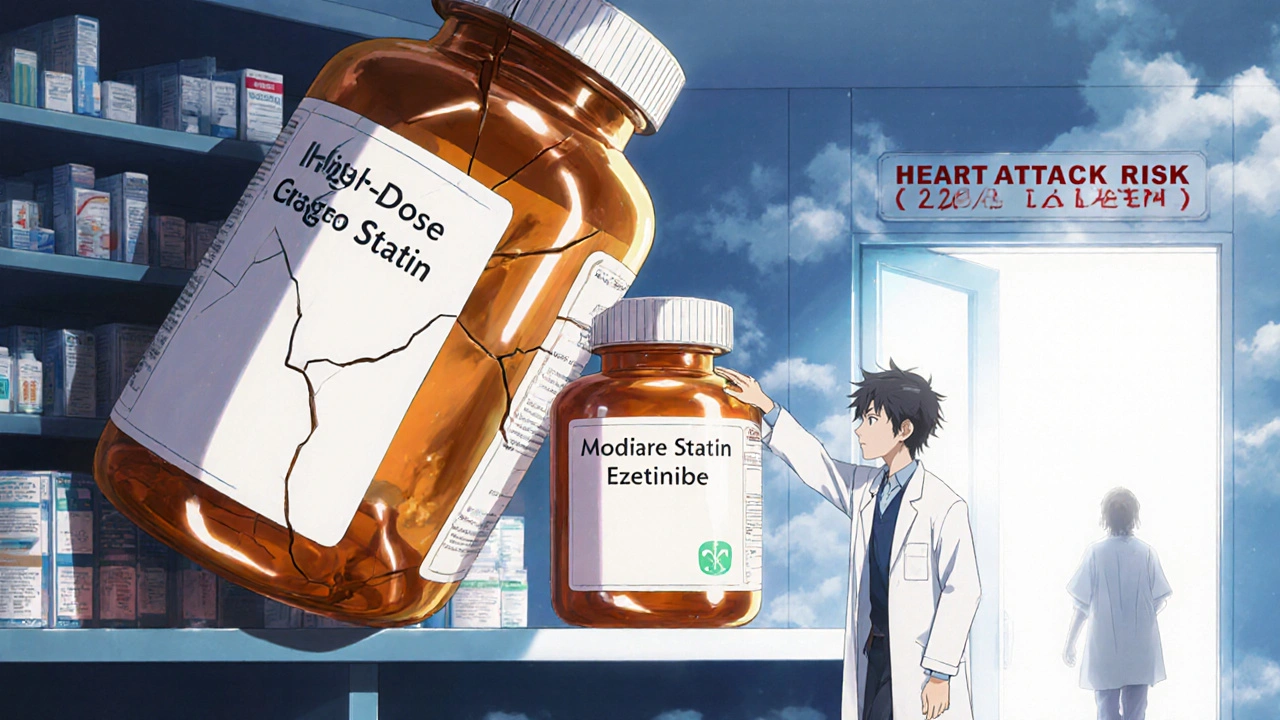
Cost vs. Value
Yes, ezetimibe costs $300-$400 a year in the U.S. PCSK9 inhibitors cost over $10,000. But here’s the truth: every dollar spent on lowering LDL reduces future hospital bills. A 2021 study showed combination therapy becomes cost-effective when LDL drops more than 30% in high-risk patients. That’s almost always the case.In Australia, ezetimibe is subsidized under the PBS. In the U.S., generic versions are widely available. The real cost isn’t the pill-it’s the missed heart attack, the emergency room visit, the lost time at work.
What You Can Do
If you’re on a high-dose statin and still not at goal-or if you’re struggling with side effects-ask your doctor about combination therapy. Don’t assume you need more statin. Ask: ‘Could adding ezetimibe get me to target with a lower dose?’Bring the numbers. Show your LDL. Ask what your target should be. If you’re high-risk, that target is often below 55 mg/dL. If you’re not there, combination therapy isn’t a backup plan anymore. It’s the first move.
It’s not about taking more pills. It’s about taking the right ones. And sometimes, less statin is more effective.
Is combination cholesterol therapy safe?
Yes, when used as directed. Statins and ezetimibe have been studied together for over a decade. Large trials like IMPROVE-IT tracked 18,000 patients for years and found no increase in serious side effects from combining them. Muscle pain, liver issues, and diabetes risk are not worsened by adding ezetimibe. The main safety benefit is that you can use a lower statin dose, which reduces side effects.
Can I just take ezetimibe without a statin?
Ezetimibe alone lowers LDL by about 18-20%. That’s not enough for most people with heart disease, diabetes, or very high cholesterol. It’s designed to be used with a statin. For people who truly can’t take any statin, bempedoic acid or PCSK9 inhibitors are better alternatives. But for most, the combo works best.
How long does it take to see results with combination therapy?
You’ll usually see your LDL drop within 2 to 4 weeks. Blood tests at 6 weeks confirm the full effect. In studies, patients reached their LDL targets 4.2 months faster with combination therapy than with statin alone. That’s a big difference when you’re trying to prevent another heart event.
Do I need to take these pills forever?
For most people with heart disease, diabetes, or inherited high cholesterol, yes. Cholesterol doesn’t fix itself. Stopping the meds means LDL rises again. The goal is long-term protection. Think of it like blood pressure or diabetes meds-you don’t stop just because you feel fine. You keep going because the risk is still there.
Will my insurance cover combination therapy?
In most cases, yes. Ezetimibe is generic and inexpensive. PCSK9 inhibitors require prior authorization and are usually reserved for those who don’t respond to other treatments. If your doctor prescribes combination therapy and your insurer denies it, ask for a letter of medical necessity. Many insurers approve it when LDL targets aren’t met with statins alone.


This is the kind of info every doc should hand out with a statin script. I was on 80mg atorvastatin and felt like a zombie. Switched to 40mg + ezetimibe and my muscles stopped screaming. LDL dropped from 92 to 61 in 8 weeks. No more panic attacks at the gym. Why isn’t this the default?
Doctors still treat cholesterol like a volume knob - turn it up till it breaks. But it’s not a speaker. It’s a system. And systems work better with balance.