
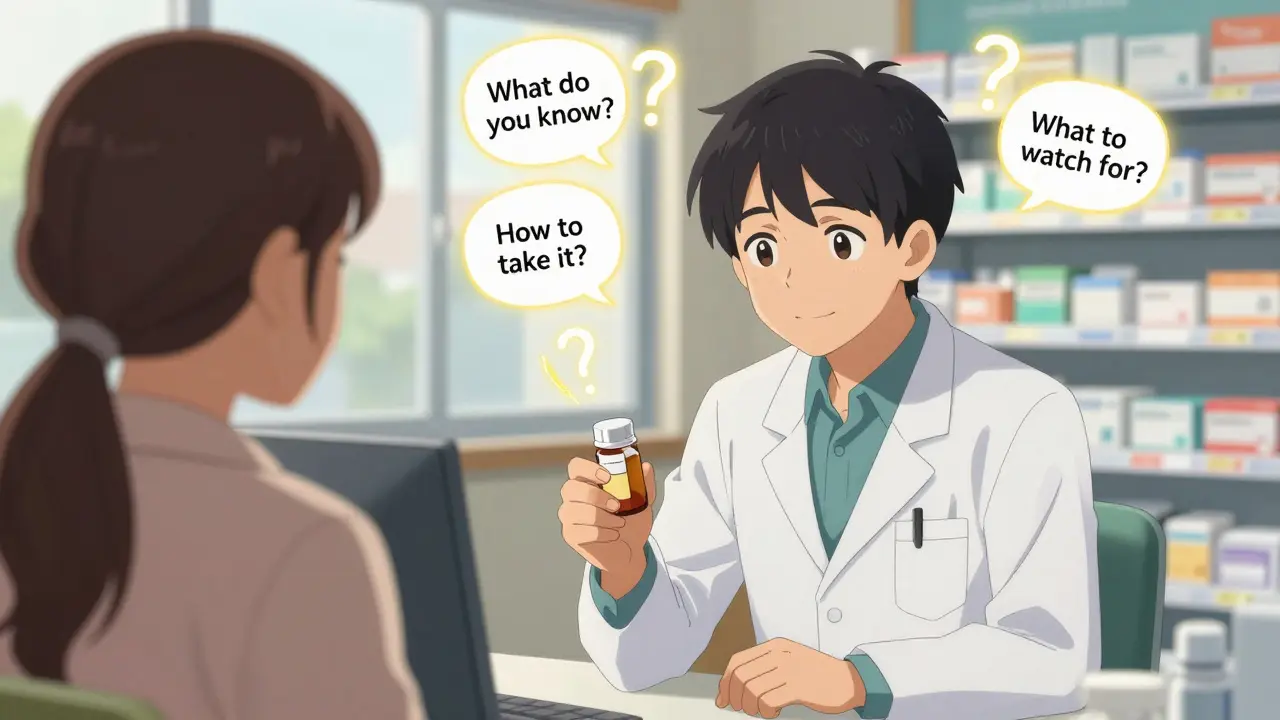
When a pharmacist hands you a new prescription, they’re not just giving you pills-they’re giving you a plan. And that plan only works if you understand it. But in a busy pharmacy, with 20 people waiting and a 90-second window to talk, how do you make sure every patient walks away with the right information? That’s where pharmacist counseling scripts come in.
Why Scripts Aren’t Just Scripts
You might think counseling scripts are rigid, robotic templates-something you read word-for-word like a robot. But that’s not how they work in practice. Real scripts are frameworks. They’re the safety net that keeps you from forgetting the critical stuff when you’re rushing between prescriptions. The foundation comes from the 1997 ASHP Guidelines on Pharmacist-Conducted Patient Education. It didn’t say pharmacists should offer counseling. It said they must provide it. Simply saying, “Do you have any questions?” isn’t enough. That’s not counseling. That’s hoping. OBRA ’90 changed everything. When Medicaid started requiring counseling for reimbursement, pharmacies had to systematize what used to be hit-or-miss conversations. Suddenly, there was a legal reason to be consistent. And that’s when scripts became more than just helpful-they became necessary.The Three Core Questions Every Script Must Answer
Not all scripts are the same, but the most effective ones-especially for new pharmacists-follow a simple, proven structure. The Indian Health Service model, cited in dozens of studies, boils it down to three questions:- What do you already know about this medicine?
- How and when should you take it?
- What problems should you watch out for?
What You Can’t Skip: OBRA ’90 and State Rules
If you’re training in the U.S., you need to know what the law says. OBRA ’90 requires pharmacists to counsel on seven key points for every new prescription:- The name and description of the drug
- The dosage form
- The route of administration
- The dosage
- The duration of therapy
- Special directions and precautions
- Common severe side effects
When Scripts Go Wrong
I’ve seen it happen. A pharmacist reads from a corporate script like a teleprompter: “This medication is used to treat hypertension. Take one tablet by mouth daily. Side effects may include dizziness, headache, and nausea.” The patient nods. The pharmacist checks the box. Done. But the patient doesn’t understand what “hypertension” means. They think “daily” means once a day-no matter what time. And they’re too embarrassed to say they don’t know how to swallow a pill. That’s the danger of over-scripting. When you treat counseling like a compliance task instead of a conversation, you lose the human connection. Experts like Dr. William Ellis from the Journal of the American Pharmacists Association warn that this creates artificial interactions. Patients feel like they’re being processed, not cared for. The fix? Teach the “teach-back” method. After explaining something, ask: “Can you tell me how you’ll take this at home?” If they say, “I’ll take it when I remember,” you know you need to re-explain. If they say, “I’ll take one in the morning with breakfast,” you know you got through. This isn’t extra work. It’s the difference between someone taking their medicine and someone ending up in the ER.
Special Cases Need Special Scripts
Not all medications are the same. A script for a blood pressure pill won’t work for an opioid. For opioids, the script has to include:- How to store it safely (away from kids, locked up)
- How to dispose of unused pills (take-back programs, flushing if no option)
- That naloxone is available-free, no prescription needed-in most states
- Signs of overdose (slow breathing, unresponsiveness)
Technology Is Changing How Scripts Work
Gone are the days of paper logs and handwritten notes. Today, 92% of chain pharmacies use electronic systems that trigger counseling prompts right when the prescription is filled. Some systems even auto-fill documentation based on what you say. Walgreens, for example, integrated scripts into their EHR in 2021. Result? Counseling time dropped 35%, documentation compliance hit 98.7%, and pharmacists reported less stress. But the real game-changer is AI. Pilot programs at CVS and Walgreens are testing dynamic scripts that adjust in real time. If a patient says, “I don’t like taking pills,” the system suggests: “Would you like to know if this comes in liquid form?” If they mention memory issues, it prompts: “Would a pill organizer help?” Early results show a 23% improvement in patient comprehension. That’s not science fiction-it’s happening now.What Works in the Real World
Practitioners on Pharmacy Times forums say the Indian Health Service three-question model cuts average counseling time from 4.2 minutes to 2.9 minutes-without losing quality. That’s huge in a pharmacy where you’re doing 100 prescriptions a day. But not everyone’s happy. A 2022 survey found 42% of pharmacists felt “script fatigue”-especially when corporate rules forced them to use scripts that ignored patient literacy, language, or culture. The solution? Customize. Give pharmacists a core framework, then let them adapt. Offer translated handouts. Use video demos for complex instructions. Train them to recognize when a patient needs more time. And never forget: if a patient can’t speak English, your script needs a translator-not just a printed sheet. Language Access Network provides materials in over 150 languages. Telephonic interpreters are available 24/7. These aren’t luxuries. They’re requirements under HIPAA and civil rights law.
How to Get Started
If you’re training new pharmacists, here’s your roadmap:- Start with OBRA ’90’s seven points. Master those before anything else.
- Learn the three-question framework. Practice it with role-playing-no notes, just conversation.
- Use the teach-back method in every session. Record yourself. Listen back. Where did you lose them?
- Learn your state’s rules. Don’t assume what works in one state works everywhere.
- Practice with special cases: opioids, anticoagulants, diabetes meds. Each needs its own approach.
- Get feedback. Ask patients: “Was that clear?” Don’t assume it was.
The Bigger Picture
Medication non-adherence costs the U.S. $312 billion a year. That’s not just money-it’s hospital stays, ER visits, and lives lost. Pharmacist counseling is one of the most cost-effective interventions we have. A 2024 study showed that patients who received structured counseling were 40% more likely to take their meds as prescribed. And the trend is clear: 43 states introduced bills in 2023-2024 to expand pharmacist counseling authority. More states are starting to pay pharmacists for this work. It’s no longer just a service. It’s becoming a recognized part of healthcare. The future isn’t about perfect scripts. It’s about smart, adaptable, human-centered conversations-backed by structure, not replaced by it.Are pharmacist counseling scripts mandatory in all states?
No. Requirements vary by state. In 32 states, pharmacists only need to offer counseling. In 18 states, they must provide it. Some states, like California, require detailed documentation of what was said. Always check your state’s pharmacy board rules.
What’s the difference between OBRA '90 and ASHP guidelines?
OBRA '90 is a federal law that mandates counseling for Medicaid patients and lists seven required topics. ASHP guidelines are professional standards that go further-they say counseling isn’t optional, and they emphasize patient understanding, not just compliance. ASHP is what you learn in pharmacy school; OBRA '90 is what you’re legally required to do.
Can I use the same script for every patient?
No. Scripts are templates, not scripts to read word-for-word. A 75-year-old with low health literacy needs a different approach than a 30-year-old tech worker. Always adjust based on what the patient already knows, their language, and their concerns.
How do I handle patients who don’t speak English?
Use professional interpreters-either in person or by phone. Never rely on family members or untrained staff. Many pharmacies use services like Language Access Network, which provides translated materials in over 150 languages. HIPAA requires confidentiality, so even language support must be secure.
Do I need to document every counseling session?
Yes. You must document whether counseling was offered, accepted, and provided-or refused. You also need to note your assessment of the patient’s understanding. Most pharmacies use EHR checkboxes, but in states like California, you may need to write a short note. Always follow your pharmacy’s policy and state law.
What’s the teach-back method, and why is it important?
Teach-back means asking the patient to explain back in their own words what they’ve been told. For example: “Can you tell me how you’ll take this pill?” If they get it right, you know they understood. If not, you re-explain. It’s the most effective way to catch misunderstandings before they lead to errors.
Are there free resources for pharmacist counseling scripts?
Yes. The CDC, ASHP, and the Pharmaceutical Society of Ireland offer free downloadable counseling templates. Many state pharmacy associations also provide state-specific scripts. Avoid commercial scripts unless they’re customizable-many are too rigid for real-world use.


Okay but let’s be real-most scripts are written by people who’ve never stepped foot in a pharmacy at 3 PM on a Friday. I’ve seen pharmacists read from a damn PowerPoint during counseling. Patients zone out. They nod. They leave. And then they don’t take the med because they thought ‘once daily’ meant ‘whenever I remember.’
Scripts aren’t the problem. Rigid, corporate, one-size-fits-all scripts are. We need frameworks that breathe. That let the pharmacist be a human, not a voice actor.