
Medication Timing Checker
Check Your Medication Timing
Enter your medication name to see if it should be taken with food or on an empty stomach.
Enter a medication name to get timing instructions.
Have you ever taken a pill with your morning coffee, only to wonder if it even worked? Or maybe you’ve skipped a dose because you weren’t sure whether to take it before or after eating. You’re not alone. For many people, figuring out when to take medication - with food or on an empty stomach - is confusing, and the consequences can be serious. A 2023 review by GoodRx found that about 25% of prescription drugs have specific food rules that directly affect how well they work. Get it wrong, and you might be getting only half the benefit - or risking side effects you didn’t expect.
Why Food Changes How Medicines Work
It’s not magic. It’s chemistry and biology. When you eat, your body goes into digestion mode. Your stomach acid levels drop, your stomach empties slower, and bile starts flowing to help break down fats. All of this changes how drugs are absorbed into your bloodstream.
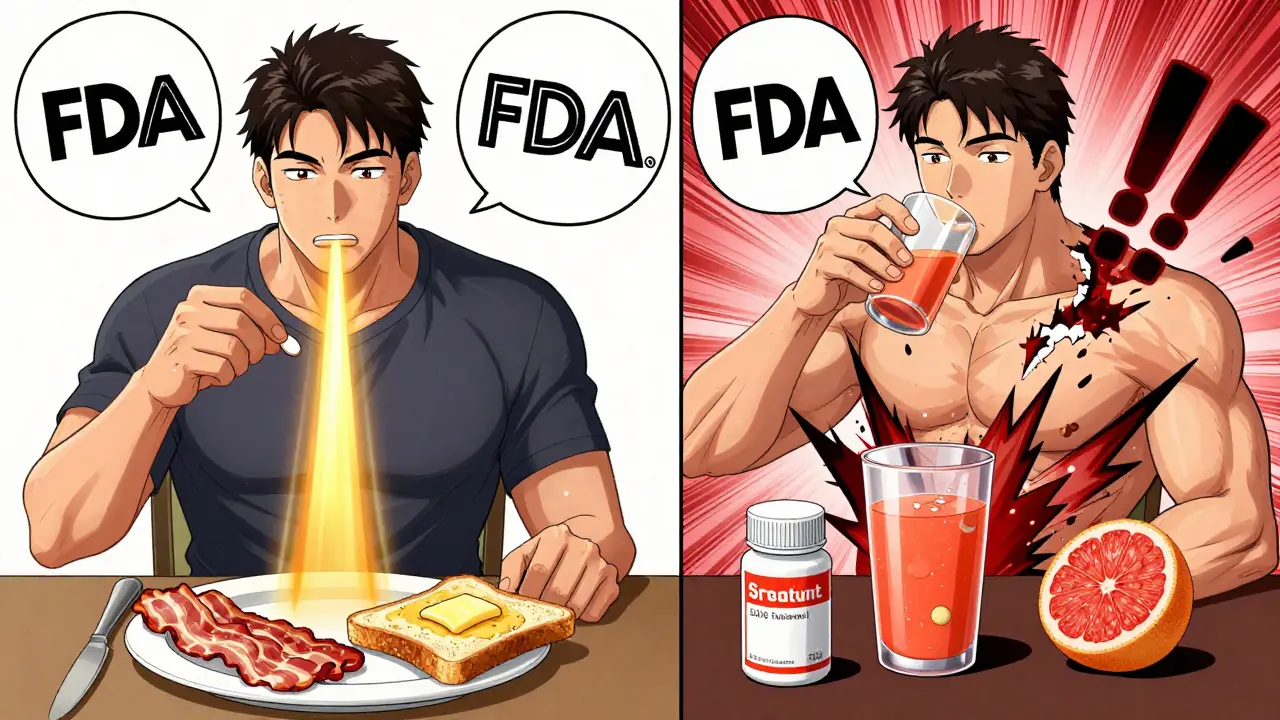
Some drugs need acid to dissolve. If you take them after eating, the higher pH from food can make them break down too slowly - or not at all. Others are fat-soluble, meaning they need fat in your meal to be absorbed properly. Then there are substances in food - like calcium, iron, or grapefruit juice - that can bind to drugs and block them from being absorbed. One study showed grapefruit juice can spike blood levels of certain statins by up to 500%, raising the risk of dangerous muscle damage.
The FDA now requires drugmakers to test new medications with both high-fat and low-fat meals before approval. In fact, since 2020, 92% of new drug labels include food instructions - up from just 65% in 2015. That means this isn’t just a minor detail. It’s a core part of how these drugs are designed to work.
Medications That Must Be Taken on an Empty Stomach
Some drugs simply don’t work well if food is around. Here are the big ones you need to know about:
- Levothyroxine (Synthroid): Used for hypothyroidism. Food - even a small snack - can cut absorption by 20% to 50%. A 2022 meta-analysis in the Journal of Clinical Endocrinology & Metabolism found that taking it with breakfast was like missing nearly a quarter of your daily dose. Patients who switched to taking it first thing in the morning, 30-60 minutes before eating, saw their TSH levels stabilize within weeks.
- Alendronate (Fosamax): A bone-strengthening drug for osteoporosis. If taken with food, its absorption drops by 60%. It also needs to be taken with a full glass of plain water and you must stay upright for 30 minutes afterward. Even coffee or orange juice can interfere.
- Sucralfate (Carafate): Used for ulcers. It needs to coat the stomach lining before food arrives. That’s why it’s taken 1 hour before meals. If you take it after eating, it won’t stick where it’s supposed to.
- Ampicillin: An antibiotic. Food reduces peak blood levels by 35% and total exposure by 28%. It’s best taken 30 minutes before or 2 hours after eating.
- Zafirlukast (Accolate): For asthma. Food cuts absorption by 40%. The FDA label says take it at least 1 hour before or 2 hours after meals.
- Omeprazole (Prilosec) and Esomeprazole (Nexium): These proton pump inhibitors work best when taken 30-60 minutes before breakfast. They block acid production triggered by food. If you take them after eating, they’re far less effective. One study showed incorrect timing dropped healing rates for esophagitis from 93% to 67% in 8 weeks.
Pro tip: The American Pharmacists Association defines "empty stomach" as 1 hour before or 2 hours after eating. So if you eat breakfast at 8 a.m., you should take these meds by 7 a.m. or wait until 10 a.m.
Medications That Need Food to Work Right
Other drugs need food to be absorbed - or to keep you from getting sick. Here’s where eating helps:
- NSAIDs (Ibuprofen, Naproxen): These can irritate your stomach lining. Taking them with food cuts the risk of ulcers and bleeding by 50% to 70%. The American College of Gastroenterology estimates that 10,000 to 20,000 hospitalizations each year from NSAID damage could be prevented with simple food timing.
- Aspirin (high dose): For pain relief, taking aspirin with food drops stomach irritation from 25% to just 8%. That’s a big difference if you’re taking it regularly.
- Duloxetine (Cymbalta): An antidepressant. About 30% fewer people report nausea when they take it with food, according to Eli Lilly’s post-marketing data.
- Atorvastatin (Lipitor) and Simvastatin (Zocor): Statins absorb better with food. But here’s the catch: grapefruit juice is a no-go. It can spike statin levels by 300-500%, increasing the risk of rhabdomyolysis - a dangerous muscle breakdown. The Canadian Medical Association Journal flagged this as a top safety issue in 2023.
- Griseofulvin: An antifungal. Food - especially fatty meals - boosts absorption by up to 50% because it needs bile to dissolve.
What About Coffee, Milk, or Orange Juice?
It’s not just meals. Even your morning drink can mess things up.
Calcium in milk or fortified orange juice can bind to antibiotics like tetracycline and doxycycline, cutting absorption by 50% to 75%. That’s why you’re told to avoid dairy for two hours before and after these drugs.
Iron supplements and calcium pills? Don’t take them with your thyroid med or antibiotics. Wait at least 4 hours. Same goes for antacids - they raise stomach pH and ruin absorption of drugs that need acid.
And coffee? It’s not just caffeine. Cream, sugar, and even the acidity can interfere. One Reddit user shared that their TSH levels were all over the place until they realized their coffee with cream was blocking Synthroid. They switched to taking it at 4 a.m. and waiting 90 minutes before anything else - and their levels finally stabilized.
How to Get It Right Every Time
Knowing the rules is one thing. Remembering them is another. Here’s how to make it stick:
- Use the 2-1-2 Rule: For empty stomach meds: take them 2 hours after eating, 1 hour before, or 2 hours after. It’s simple and gives you a buffer.
- Label your pill organizer: Use stickers or labels that say "before food" or "with food." A 2022 study in the Annals of Internal Medicine found this improved adherence by 35%.
- Check your bottle: Pharmacies like CVS and Walgreens now put color-coded stickers on prescriptions: red for empty stomach, green for with food. In a 2021 pilot study, this boosted correct use from 52% to 89%.
- Use a reminder app: Apps like Medisafe and GoodRx now send alerts for food timing. Their 2023 data shows a 28% drop in errors among users who turned on these alerts.
- Ask your pharmacist: A 2021 JAMA Internal Medicine study found pharmacists gave food-timing instructions in 92% of cases - compared to just 45% of doctors. They’re trained for this.
For complex regimens, stagger your meds. Take your empty-stomach pill at 7 a.m., then eat breakfast at 8 a.m. and take your food-requiring meds with it. That way, you’re not fighting your body’s natural rhythm.
What’s Changing in the Future
Science is catching up. New drug formulations are being designed to ignore food entirely. Johnson & Johnson’s Xarelto Advanced uses a pH-sensitive coating that keeps absorption steady whether you eat or not - variability dropped from 35% to just 8%. The University of Michigan is testing nanoparticles that bypass stomach acid altogether. Early results show 92% consistent absorption for levothyroxine, even with food.
But here’s the truth: even with these advances, 75% of today’s medications still need food timing to work right. The American College of Clinical Pharmacy says understanding the basics isn’t going away anytime soon.
And the cost of getting it wrong? It’s huge. The Institute for Safe Medication Practices says 12,000-15,000 medication errors each year are tied to food timing. Thyroid medication mistakes alone make up 22% of those. And the financial hit? Around $290 billion a year in wasted healthcare spending because people aren’t taking their meds correctly.
Bottom Line: Don’t Guess - Check
Medication timing isn’t just about following rules. It’s about making sure your treatment works. Whether you’re on a thyroid pill, an antibiotic, or a daily statin, food isn’t just background noise - it’s part of the equation.
When in doubt, ask. Look at the label. Call your pharmacist. Use a reminder app. Don’t assume your doctor told you everything - many don’t have time to go into detail. And if you’ve been taking your meds the same way for years but still feel off, food timing might be the missing piece.
It’s not about being perfect. It’s about being informed. One small change - taking your pill 30 minutes before breakfast instead of with it - could mean the difference between feeling well and feeling stuck.
Can I take my medication with just a sip of water or a small snack?
It depends on the drug. For medications like levothyroxine or alendronate, even a small snack or a glass of milk can interfere. For others, like NSAIDs, a light snack is actually recommended. Always check the label or ask your pharmacist. When in doubt, follow the "empty stomach" rule: no food for 1 hour before or 2 hours after.
What if I forget to take my medication at the right time?
If you realize you took a food-requiring drug on an empty stomach, wait until your next meal and take your next dose as scheduled. Don’t double up. If you took an empty-stomach drug with food, wait until your next scheduled dose and take it correctly then. Missing one dose won’t ruin your treatment, but doing it regularly will reduce effectiveness. Use reminders to avoid this.
Does it matter if I eat a big meal vs a light snack with my medication?
Yes, especially for drugs that need fat to absorb, like griseofulvin or some statins. A high-fat meal (500-800 calories) can significantly boost absorption. For drugs that are ruined by food, even a light snack can interfere. The FDA tests drugs using both high-fat and low-fat meals to determine instructions. If your label says "with food," aim for a regular meal, not just a cracker.
Can I take all my pills at once with breakfast?
No - not if some need an empty stomach. Taking a thyroid pill with your breakfast could cut its effectiveness in half. Same with antibiotics or bisphosphonates. Space them out. Take empty-stomach meds first thing in the morning, wait an hour, then eat and take your food-requiring pills. Use a pill organizer with labeled compartments to keep track.
Why do some medications say "take with food" but don’t specify what kind?
The goal is to reduce stomach upset or improve absorption - not to trigger a specific reaction. For most of these drugs, any regular meal works. But avoid grapefruit juice with statins, dairy with antibiotics, and antacids with thyroid meds. If you’re unsure, ask your pharmacist. They know which foods to avoid with your specific meds.


Wow, someone actually did the research. Most people just swallow pills like candy and wonder why they feel like garbage. If you’re taking levothyroxine with coffee, you’re not treating hypothyroidism-you’re performing a magic trick where the medicine disappears. And don’t even get me started on grapefruit juice. That stuff is basically a drug villain in a superhero movie.